
Your wood fence isn’t just a boundary. In Vancouver’s wet, gray winters, it’s a constant battle against moisture, moss, and slow decay. And if you’ve been putting off fence staining in Vancouver, WA, that battle is one your fence is quietly losing.
You already know something’s off. Maybe the wood has gone from warm and rich to a dull, weathered gray. Maybe you’ve spotted patches of mildew creeping across the panels, or noticed soft spots where the wood has started to give. And if you’ve ever stood in the stain aisle at a big-box store staring at dozens of cans with no idea where to start, you’re not alone. It’s genuinely overwhelming.
Here’s the good news: getting your fence looking beautiful again doesn’t have to be complicated. In this guide, you’ll learn why professional fence staining is one of the smartest investments you can make for your home in Vancouver’s climate, what to look for in a stain that actually holds up against our rain and humidity, and how working with a trusted local contractor makes the whole process simple. Let’s walk through it together.
Key Takeaways
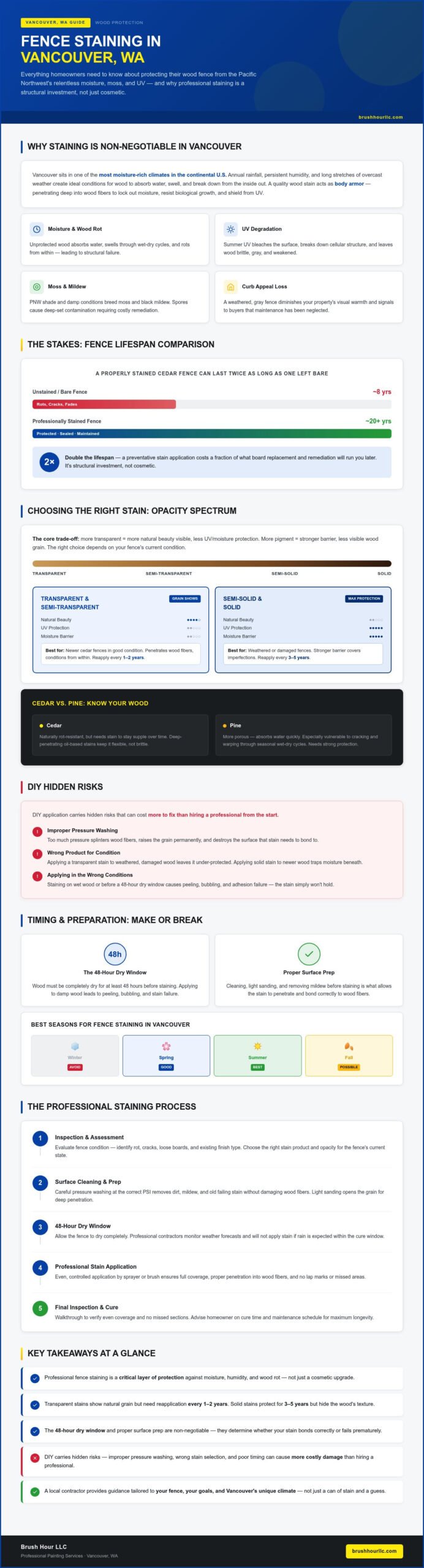
- Professional fence staining in Vancouver, WA is more than a cosmetic upgrade — it’s a critical layer of protection against the region’s relentless moisture, humidity, and risk of wood rot.
- Not all stains are created equal: understanding the difference between transparent and solid finishes helps you choose the right balance of natural beauty and long-term durability for your fence.
- Timing and preparation are everything — learn why the 48-hour dry window and proper surface prep make or break how well your stain holds up over time.
- DIY application carries hidden risks, including wood damage from improper pressure washing, that can cost more to fix than hiring a professional from the start.
- Working with a trusted local contractor means you get expert guidance tailored to your fence, your goals, and Vancouver’s unique climate — not just a can of stain and a good-luck wave.
Why Fence Staining is Essential for Vancouver, WA Homes
Think of a quality wood stain as body armor for your fence. It’s not just about color. A professional stain penetrates deep into the wood fibers, creating a protective seal that locks out moisture, resists biological growth, and shields the surface from the sun. Understanding the full range of wood stain types and finishes makes it clear why this is a structural investment, not a cosmetic one.
Vancouver sits in one of the most moisture-rich climates in the continental U.S. Annual rainfall, persistent humidity, and long stretches of overcast, damp weather create ideal conditions for wood to absorb water, swell, and slowly break down from the inside out. Left unprotected, that process accelerates into rot and structural failure. Fence staining in Vancouver, WA isn’t optional maintenance. It’s the front line of defense against a climate that genuinely works against your fence year-round.
And it’s not just rain you’re fighting. Vancouver summers bring real UV exposure, and sunlight degrades wood fibers just as aggressively as moisture does. It bleaches the surface, breaks down the cellular structure, and leaves wood brittle and gray. A quality stain with UV inhibitors slows that breakdown significantly, keeping your fence looking warm and intentional instead of sun-beaten and forgotten.
There’s also the curb appeal factor. A freshly stained fence transforms the entire feel of your backyard. It frames your outdoor space, adds visual warmth, and signals to neighbors and potential buyers alike that your home is well cared for. This is especially important for pet owners who want a secure, attractive space for their animals; H&H Dog even offers insights into some of the rarest breeds that might inhabit such a yard. It’s one of the highest-visibility improvements you can make with a single weekend’s work.
Combating Moss and Mildew in the PNW
Green moss and black mildew aren’t just ugly. They’re actively damaging. In the Pacific Northwest, biological growth on wood fences is almost inevitable without proper protection. Spores thrive in the damp shade that Vancouver’s tree canopy and gray skies provide. Professional-grade stains formulated with mildewcides inhibit this growth at the surface level, preventing the kind of deep-set contamination that requires aggressive treatment to reverse. The cost of a preventative stain application is a fraction of what remediation and board replacement will run you later.
Extending the Life of Your Cedar or Pine Fence
Cedar and pine, the two most common fence materials in the Vancouver area, respond very differently to moisture. Cedar is naturally rot-resistant but still needs help staying supple over time. Pine is more porous and absorbs water quickly, making it especially vulnerable to cracking and warping through seasonal wet-dry cycles. Deep-penetrating oil-based stains work for both species by conditioning the wood from within, keeping it flexible rather than brittle. Simply put, a properly stained cedar fence can last twice as long as one left bare and exposed to the elements. That’s not a small return on a straightforward service.
Fence staining in Vancouver, WA done right is one of the smartest, most cost-effective things you can do for your property. And the good news is that it doesn’t have to feel complicated.
Choosing the Right Stain: Transparent vs. Solid Finishes
Standing in the stain aisle is one thing. Actually knowing which product belongs on your fence is another. The single most important decision you’ll make isn’t about brand or price — it’s about opacity. How much of the wood’s natural grain do you want visible when the job is done? That answer shapes everything else.
Here’s the core trade-off: the more transparent the stain, the more natural beauty shows through, but the less UV and moisture protection you get. The more pigment in the formula, the stronger the barrier, but the more the wood grain disappears beneath it. Neither option is wrong. The right choice depends almost entirely on the current condition of your fence.
Transparent and Semi-Transparent Stains
These are the right call for newer cedar fences in good shape, where the grain is still tight, the wood is still rich, and you want to keep that natural warmth visible. Rather than sitting on the surface like a film, penetrating oil-based transparent stains soak into the wood fibers and condition from within. The result looks intentional and organic rather than painted.
The trade-off is maintenance frequency. Lighter finishes typically need reapplication every one to two years in a climate like Vancouver’s, where rainfall and humidity accelerate wear. That’s not a flaw in the product — it’s just the nature of a formula that prioritizes breathability and natural appearance over maximum protection. If you’re prepared for that rhythm, transparent stains are genuinely beautiful.
Solid and Semi-Solid Stains
For older, weathered fences, solid stains are the smarter move. Higher pigment loads mean superior UV protection and a stronger moisture barrier. They also do something transparent stains simply can’t: they visually unify a fence that’s gone patchy, gray, or inconsistent over the years. Instead of highlighting imperfections, they cover them cleanly.
Solid stains also open up a design opportunity worth considering. Working with a contractor who understands exterior house painting means your fence color can be matched intentionally to your home’s trim or siding, creating a cohesive, pulled-together look that adds real curb appeal. Semi-solid options split the difference nicely, offering stronger protection than transparent formulas while still letting some grain texture show through.
When it comes to fence staining in Vancouver, WA, the condition of your wood is the deciding factor. New fence with tight grain? Go transparent. Weathered boards with gray patches and surface wear? Solid is your friend. Not sure which category your fence falls into? That’s exactly the kind of call a local professional can make on-site, without any guesswork on your end. Get a professional eye on your fence before committing to a finish.
The Professional Fence Staining Process Explained
Here’s something most homeowners don’t realize: the quality of a staining job is decided before a single drop of stain ever touches the wood. Preparation isn’t a preliminary step. It’s the whole game. A beautiful finish applied to poorly prepped wood will peel, blotch, and fail within a season. Getting it right the first time means following a process, not just a product recommendation.
Step 1: Deep Cleaning and Restoration
The first thing a professional does is assess what’s actually on your fence. Mold spores, mildew, oxidized gray fibers, and old stain residue all create a barrier that prevents new stain from penetrating properly. Washing the surface with plain water pressure isn’t enough to address this. Specialized wood cleaners with the right pH balance break down biological growth and lift oxidized wood fibers at the cellular level, restoring a clean, absorbent surface that’s ready to accept stain evenly.
This is where DIY pressure washing often goes wrong. Too much pressure, or the wrong nozzle angle, raises the wood grain and creates “furring,” a fuzzy, damaged surface texture that makes even application nearly impossible. It can also drive moisture deep into the boards, which creates a different problem entirely. Staining over wet wood traps moisture inside, leading to the same swelling and breakdown you were trying to prevent in the first place.
After cleaning, professionals wait. The wood needs to reach the correct moisture level before staining begins, typically measured with a moisture meter rather than guessed by touch. In Vancouver’s damp climate, that drying window matters more than almost anywhere else. Rushing it is one of the most common and costly mistakes in fence staining Vancouver WA homeowners face when going the DIY route.
Protecting your property is part of the prep work too. Landscaping, garden beds, and nearby hardscaping get covered or masked before any cleaning or application begins. A professional crew treats your yard as carefully as they treat your fence.
Step 2: Expert Application and Clean-up
Application method depends on the fence style, the stain formula, and the surrounding space. Spraying is fast and effective for open-style fencing, but it requires careful management of overspray, especially on tight Vancouver residential lots where a neighbor’s siding or your own garden beds are just a few feet away. Back-brushing, working the stain into the wood with a brush immediately after spraying, is what separates a professional finish from a surface coating. It pushes the stain into the grain rather than letting it sit on top, which is what produces an even, non-blotchy result that actually lasts.
Once the work is done, a thorough walk-through covers the details that matter:
- Even coverage with no missed boards or lap marks
- Clean edges where the fence meets posts, gates, or concrete
- No stain bleed onto surrounding surfaces
- Consistent color tone across the entire fence line
Professional fence staining Vancouver WA done properly isn’t a rushed afternoon project. It’s a methodical process, and that discipline is exactly what makes the results last.
When is the Best Time for Fence Staining in Vancouver?
Timing a fence staining project in the Pacific Northwest isn’t just about picking a sunny weekend. It’s about understanding how Vancouver’s climate actually behaves and working with it rather than against it. Get the timing right, and your stain bonds deeply and cures beautifully. Get it wrong, and you’re looking at peeling, blotching, and a redo within a year.
The foundational rule is simple: you need a dry window of at least 48 hours before application and 48 hours after. Rain hitting fresh stain before it’s fully cured doesn’t just mar the surface. It dilutes the formula, breaks the bond, and can leave a streaky, uneven finish that no amount of touch-up work will fully correct. In a city where rain can roll in without much warning, that 48-hour window is non-negotiable.
Temperature matters just as much. Most quality stains cure best between 50°F and 90°F. Below that range, the formula thickens and won’t penetrate evenly. Above it, the stain dries too fast on the surface before it’s had a chance to soak into the wood fibers. Vancouver’s mild climate actually works in your favor here, but only during the right months.
That’s why late spring (May through early June) and early fall (September through October) are the sweet spots for fence staining Vancouver WA homeowners should be targeting. Temperatures are consistently in the ideal range, rainfall gaps are more predictable, and the brutal summer UV intensity hasn’t set in yet. Clark County’s summers do get warm, and while warm is better than cold for curing, extreme heat creates its own application challenges.
Monitoring Moisture Levels
Surface dryness can be misleading. Wood that looks dry to the touch after a stretch of clear weather can still hold significant internal moisture, especially in shaded fence sections or boards close to the ground. Professionals use moisture meters to confirm the wood is genuinely ready, not just dry on the surface. Morning dew and evening humidity are real factors too. Even on a dry day, staining in the early morning or late afternoon can mean applying product to wood that hasn’t fully dried from overnight moisture. Staining damp wood traps that moisture inside, which leads to the swelling, peeling, and premature failure you were trying to prevent from the start.
Scheduling Your Project
Once you know your timing window, a little preparation goes a long way. Move patio furniture, potted plants, and anything stored along the fence line before the crew arrives. Trim back any vegetation growing against the boards so every surface is accessible. Most residential fences can be completed in one to two dry days, so your yard won’t be out of commission for long.
One thing worth knowing: residential painting near me searches spike hard in spring, and professional calendars in Vancouver fill up fast. By April, summer slots are often already spoken for. If you’re aiming for that ideal late spring window, reaching out early is the smartest move you can make. Get on the schedule with Brush Hour before the season fills up.
Why Choose Brush Hour LLC for Your Vancouver Fence Project?
There’s no shortage of contractors who will show up, spray something on your fence, and hand you an invoice. What’s harder to find is someone who actually takes the time to understand what your fence needs, explains the options clearly, and treats your property with the same care they’d give their own. That’s the difference Brush Hour LLC brings to every project.
As a licensed and insured contractor serving the Vancouver and Battle Ground area, Brush Hour LLC operates with the kind of accountability that protects you. Licensing means the work meets professional standards. Insurance means that if anything unexpected happens on your property during the project, you’re not left holding the bill. Those aren’t small things. They’re the baseline of what a trustworthy contractor looks like, and not every company you’ll find in a quick search can say the same.
Beyond credentials, the approach is different. Brush Hour isn’t here to upsell you on the most expensive product or rush through a job to get to the next one. The goal is to be a genuine resource, someone who helps you understand what your fence actually needs and why, so you can make a confident decision. That’s what “helpful local expert” means in practice, not just in a tagline.
Fence staining also doesn’t exist in isolation. Your fence is part of how your home looks from the street. Brush Hour’s background in exterior painting means your fence color can be considered alongside your trim, siding, and overall exterior palette, creating a cohesive look rather than a disconnected afterthought. That kind of integrated thinking is something a fence-only crew simply can’t offer.
Precise Craftsmanship and Reliable Results
The details matter. Every picket bottom, every post cap, every gate edge. Brush Hour’s focus on precise craftsmanship means nothing gets skimped because it’s low or hard to reach. Prep, application, and clean-up are all handled, so you’re not left with stain-speckled pavers or a half-finished edge near the gate latch. The job isn’t done until the whole fence looks exactly right.
Get Started with a Free Consultation
Getting started is straightforward. Reach out to Brush Hour LLC and we’ll schedule a site visit to assess your fence in person. We’ll look at the wood condition, identify any problem areas, and walk you through which finish makes the most sense for your specific situation. No pressure, no guesswork, just honest guidance from someone who knows fence staining Vancouver WA homeowners can actually rely on.
Your yard deserves better than weathered gray boards and a can of stain you’re not sure how to use. Contact Brush Hour LLC today for a free estimate and let’s get your fence looking the way it should.
Your Fence Deserves Better Than Another Wet Winter Without Protection
Vancouver’s climate doesn’t take breaks, and neither does the damage it does to unprotected wood. The right stain, applied at the right time by someone who knows what they’re doing, is what stands between your fence and years of costly repairs.
Here’s what it comes down to: preparation determines the result, timing determines how long it lasts, and the right finish depends entirely on your fence’s current condition. Get those three things right, and you’re looking at a fence that holds up beautifully through everything the Pacific Northwest throws at it.
Brush Hour LLC has been helping Vancouver and Battle Ground homeowners protect their properties as a licensed and insured contractor with deep roots in the local community. The process is simple, the guidance is honest, and the results speak for themselves.
Don’t let another rainy season chip away at your investment. Request your free fence staining Vancouver WA quote from Brush Hour LLC today and let’s get your fence looking exactly the way it should.
Frequently Asked Questions About Fence Staining in Vancouver, WA
How Often Should I Stain My Fence in Vancouver, WA?
Most wood fences in Vancouver need restaining every one to three years, depending on the finish you’ve chosen and how much weather exposure your fence gets. Transparent and semi-transparent stains wear faster and typically need attention every one to two years. Solid stains hold up longer, often stretching to three years before a refresh is needed. A quick check each spring will tell you a lot: if water no longer beads on the surface, it’s time.
Do I Need to Pressure Wash My Fence Before Staining?
Cleaning is essential, but pressure washing requires real care. Too much pressure or the wrong nozzle angle damages wood fibers and raises the grain, leaving a fuzzy surface that stain can’t penetrate evenly. A better approach combines low-pressure rinsing with a pH-balanced wood cleaner designed to lift mildew, oxidation, and old residue without roughing up the surface. After cleaning, the wood needs adequate drying time before any stain goes on.
Can You Stain a Fence That Has Already Turned Gray?
Yes, and it’s one of the most satisfying transformations you can make. That gray color isn’t just surface dirt; it’s oxidized wood fiber that needs to be treated with a wood brightener or restoration cleaner before staining. Once those dead fibers are lifted and the surface is properly prepped, a semi-solid or solid stain will absorb evenly and bring the fence back to life. Skipping the restoration step and staining over gray wood leads to a blotchy, uneven result.
Is It Better to Spray or Roll Stain onto a Wood Fence?
Spraying is faster and works well for open-style fencing, but it’s only half the job. The real key is back-brushing, working the stain into the wood with a brush immediately after spraying. This pushes the formula into the grain rather than leaving it sitting on top, which is what produces a finish that actually lasts. Rolling alone tends to leave stain on the surface rather than inside the wood, which shortens the life of the application considerably.
How Long Does the Stain Need to Dry Before It Rains?
Most quality fence stains need at least 24 to 48 hours of dry weather after application to cure properly. Rain hitting fresh stain before that window closes doesn’t just mar the surface; it can dilute the formula and break the bond between the stain and the wood. For fence staining in Vancouver, WA, this dry window is the single most important scheduling factor. Always check a reliable local forecast and build in buffer time beyond the minimum.
Will Staining My Fence Kill My Plants or Grass?
Many stain formulas, particularly oil-based products, can harm plants and grass if they come into direct contact. A professional crew covers garden beds, lawn edges, and landscaping near the fence line before any application begins. If you’re tackling this yourself, use plastic sheeting or drop cloths to protect vegetation, and water nearby plants thoroughly before and after the project to dilute any accidental contact. Don’t skip this step; replacing mature plants costs far more than a roll of protective sheeting.
Should I Stain a Brand-New Cedar Fence Immediately?
Not right away. New cedar needs time to dry out and release its natural oils before it can properly accept a stain. Applying product too soon means the stain can’t penetrate evenly, leading to a blotchy finish that peels prematurely. Most professionals recommend waiting four to six weeks after installation, though the exact window depends on how the lumber was stored and your local weather conditions. A moisture meter reading below 15 percent is a reliable green light.
What Is the Difference Between a Fence Sealer and a Fence Stain?
A sealer is primarily a moisture barrier; it sits on the surface and repels water but doesn’t add color or UV protection. A stain penetrates the wood, adds pigment, and typically includes UV inhibitors and mildewcides that a basic sealer doesn’t offer. In a climate like Vancouver’s, where you’re fighting moisture, biological growth, and sun exposure all at once, a quality stain does significantly more work than a sealer alone. Some products combine both functions, but it’s worth confirming what’s actually in the formula before you buy.
If you are also interested in protecting your home’s masonry or driveway, you can discover Snugs Services to see how specialized sealing solutions apply to other exterior surfaces.