
Why does one professional estimate feel like a steal while the next gives you immediate sticker shock? It’s a common frustration for homeowners trying to pin down house painting prices in 2026. You’re looking for a fresh look and reliable protection against the damp Pacific Northwest climate, but inconsistent bids make it hard to know what’s fair. We understand that confusion. It’s tough to balance the need for high-quality materials with a realistic budget, especially when you’re worried about paint failing after just one rainy season.
You deserve a transparent look at where your money actually goes. This guide will help you master the variables of painting costs and use our budgeting framework to plan your next home transformation with confidence. We’ll explore the real split between labor and materials, the impact of 2026’s smart paint technologies, and how to choose a licensed contractor who treats your home like their own. By the end, you’ll have a clear roadmap for your project and the peace of mind that comes with a well-planned investment.
Key Takeaways
- Understand how labor, materials, and prep work combine to create your estimate and why bids for the same house can vary so significantly.
- Master the variables behind house painting prices to avoid sticker shock and identify the difference between a low-ball offer and a fair investment.
- Learn why exterior projects often require a higher budget due to specialized equipment and the unique durability needs of the Pacific Northwest.
- Use our step-by-step budgeting framework and “Quick Math” formula to calculate a realistic estimate for your specific home size.
- Gain confidence in your hiring process by seeing how local expertise in Vancouver and Battle Ground leads to transparent, no-surprise quotes.
Why Do House Painting Prices Vary So Much in 2026?
Have you ever wondered why three different contractors can look at the exact same room and give you three wildly different numbers? It’s enough to make any homeowner feel a bit uneasy. Understanding house painting prices starts with realizing that you aren’t just buying a few gallons of color. You’re investing in a complex blend of professional labor, high-performance materials, and intensive surface preparation. In 2026, the market has also been shaped by the rise of specialized smart coatings and shifting supply costs, making the “why” behind your quote more important than ever.
Think of it this way. A $2,000 bid and a $6,000 bid for the same house aren’t usually offering the same service. The lower price often covers a “refresh,” where paint is applied quickly over existing surfaces. The higher price usually represents a “restoration,” involving deep cleaning, meticulous sanding, and premium primers. A skilled house painter and decorator knows that the value isn’t in the initial price tag, but in the total cost of ownership. If a cheap job peels after two winters in our damp climate, you’ll end up paying for the whole thing again much sooner than you planned.
The “Cheap Bid” Trap: What Are You Sacrificing?
The Impact of Home Condition on Your Estimate
Breaking Down Interior vs. Exterior Painting Costs
How do you calculate a fair price for your project? It starts by looking at the specific area you’re transforming. Many homeowners feel confused when they look at their floor plans. A 2,000 square foot home refers to the floor space, but your painter is calculating the surface area of the walls, ceilings, and trim. This total paintable area is much larger than the footprint of the house itself. When comparing house painting prices, the environment plays the biggest role. Interior work focuses on precision and protecting your furniture, while exterior work focuses on weatherproofing and navigating heights.
The equipment needed for these two types of projects is also vastly different. For an interior job, we use drop cloths, painters tape, and high-quality rollers. For an exterior job, we might need pressure washers, industrial sprayers, and specialized safety gear. These tools ensure the finish is even and durable, but they also influence the overall budget. If you’re planning a full home refresh, it helps to view these as two distinct phases with their own unique requirements.
Interior Painting Price Variables
Is it better to price by the room or by the square foot? Most pros use a square footage model for the actual surface area, but room-by-room pricing helps you prioritize your budget. Specialized rooms like kitchens and bathrooms often require premium, moisture-resistant sheens that can withstand steam and scrubbing. This is where interior house painters really shine. They understand how to handle the detail work on baseboards, window casings, and doors. These elements take more time than flat walls because they require steady hands and specific brushes to get that crisp, professional look.
Exterior Painting Price Variables
Why does exterior work often carry a higher price tag? It’s largely about the scale and the siding material. A single-story ranch is a straightforward job, but a multi-story home requires specialized ladders, scaffolding, or even mechanical lifts. Safety is a major cost driver here. According to data on Painters, Construction and Maintenance, the skilled labor required for these high-risk environments is a significant part of the total investment. Your siding material also changes the math. Vinyl siding takes paint differently than thirsty cedar or fiber-cement HardiePlank. Each material requires a specific primer and application technique to ensure the finish doesn’t bubble in the sun. Don’t forget the extras like shutters, porch ceilings, and gutters. These finishing touches add curb appeal but also add to the labor hours. If you’re feeling stuck on the numbers, connecting with a local expert can help clarify which services your home actually needs right now.
The Real Cost Drivers: Labor, Materials, and the PNW Factor
Most homeowners think they’re primarily paying for the paint in the bucket. In reality, you’re paying for the time and expertise of the person holding the brush. Labor usually accounts for 70% to 80% of your total professional bid. This isn’t just about the act of rolling color onto a wall; it’s about the technical skill required to ensure that color stays there for a decade. When you evaluate house painting prices, it’s vital to view labor as an investment in your home’s longevity rather than just a simple service fee.
In 2026, the market has shifted toward high-performance, specialized coatings. While these materials might have a higher upfront cost, they’re designed to save you money over the life of your home. A cheaper product often requires three coats to achieve the same coverage that a premium paint reaches in two. This means a “bargain” paint actually increases your labor costs because the crew has to spend more time on the job. Investing in quality from the start is the smartest way to manage your long-term budget.
Why Labor is Your Biggest (and Best) Investment
Why does professional painting take so long? A great crew spends the majority of their time on scraping, sanding, and caulking. This intensive prep work is the only way to prevent peeling and bubbling down the road. You’re also paying for the security of professional insurance and workers’ comp. If you look at the official painter wage data, you’ll see that skilled tradespeople command a fair rate for this demanding work. Their expert technique also reduces material waste, ensuring every drop of paint is used efficiently without leaving a mess behind.
Premium Materials vs. Budget Paint
Material costs in 2026 reflect a growing demand for health and durability. We prioritize low-VOC and zero-VOC options for interior projects to ensure your family isn’t breathing in harsh chemicals. For exterior work, high-quality primers are a non-negotiable requirement. These primers act as a moisture barrier, which is essential for protecting your siding from the elements. A premium exterior finish won’t just look better; it will resist UV fading and cracking much longer than a budget alternative.
Vancouver & Battle Ground Local Considerations
Living in Vancouver or Battle Ground adds a specific “weather tax” to your project. Our rainy season creates a narrow window for exterior work, typically running from mid-May through September. Moss and mildew remediation are standard prep steps here because of our constant moisture. If a contractor skips these steps, your new finish will fail within a year. Local humidity also affects how long paint takes to dry, which can occasionally extend labor hours. Choosing residential painting near me gives you a team that knows these quirks. They understand that house painting prices in the Pacific Northwest must account for the extra armor your home needs to survive the gray.
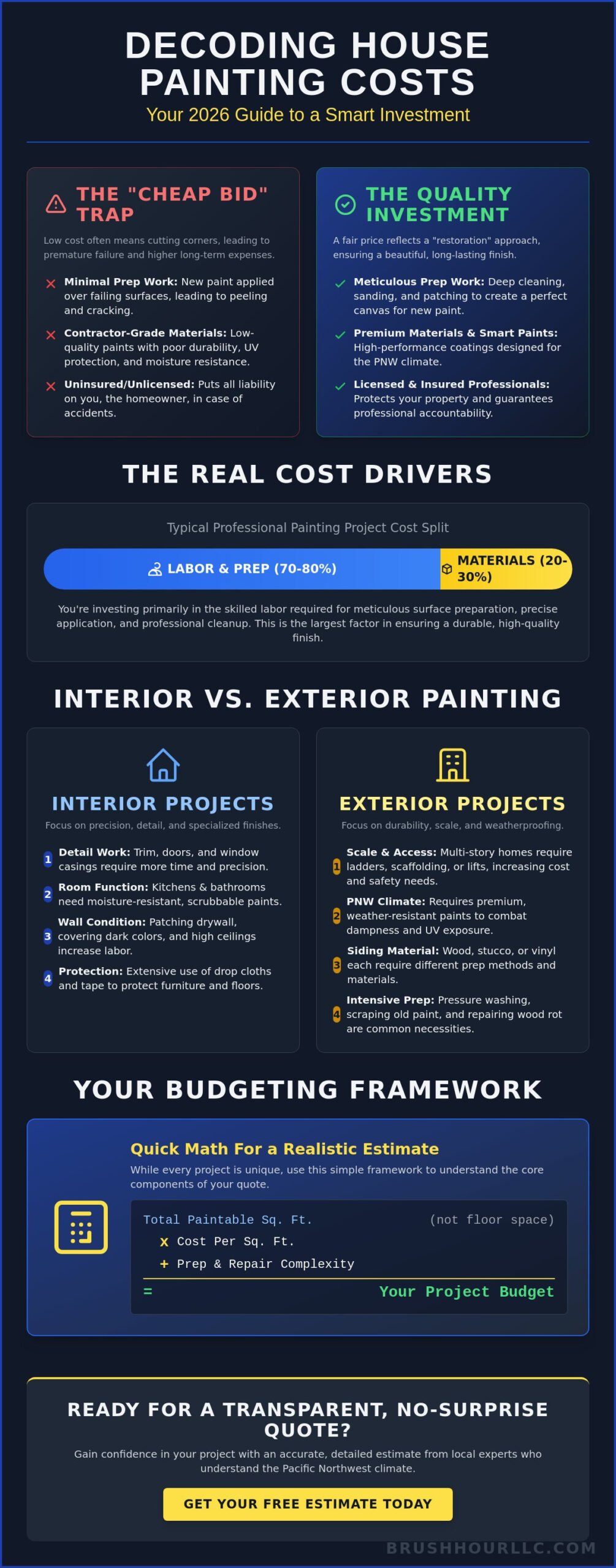
Your House Painting Budget Template: A Step-by-Step Guide
Want to know if that quote you received is in the right ballpark? Creating your own estimate helps you spot red flags and understand house painting prices before you ever sign a contract. Think of this framework as your personal budgeting tool. It isn’t a final contract price, but it puts you in the driver’s seat during the bidding process. By doing a little homework now, you can avoid the stress of unexpected costs later. For more complex transformations, reading our guide on professional wall painting can help you decide which parts of the project you want to tackle yourself.
Step 1: Measuring Your Paintable Surface Area
How do you get an accurate measurement without a professional laser tool? Start by calculating the total square footage of your walls. To measure a standard 12×12 room for paint, calculate the perimeter (48 feet) and multiply it by the ceiling height (usually 8 feet) to get 384 square feet of wall space. Now, subtract the areas that won’t be painted. Subtract about 21 square feet for each standard door and 15 square feet for each average window. As a rule of thumb, add 15% to your total if you plan on painting the ceiling and baseboards too. This gives you the actual paintable surface area that drives your material needs.
Step 2: Factoring in Prep and Complexity
Is your project a simple color refresh or a major change? If you’re going from a dark charcoal to a soft white, you need to add a “complexity multiplier” to your budget. This usually adds 20% to 30% to the labor and material cost because of the extra priming required. Don’t forget to look for minor drywall cracks or wood siding patches that need repair before the first drop of paint is applied. If the crew has to move heavy furniture or perform extensive masking for delicate hardwood floors, these hours will be reflected in house painting prices. High-quality results require a clean, smooth canvas.
Step 3: Comparing Professional Bids
What should you look for when the bids start rolling in? A professional estimate should always be a line-item breakdown. This means you can see exactly how much is being spent on prep work, materials, and labor. Why do experts often suggest that the “mid-range” bid is the safest? It usually indicates that the contractor isn’t cutting corners on prep but also isn’t overcharging for massive corporate overhead. Ask your painter direct questions. Does the price include two coats of finish? How will they protect your landscaping? Getting these answers upfront ensures a smooth, no-surprise transformation. Ready to see what a transparent estimate looks like? You can request a personalized quote to get started on your home’s new look.
Navigating Your Quote: How Brush Hour LLC Ensures Pricing Accuracy
Does the thought of a surprise bill halfway through your project keep you up at night? We know that house painting prices can feel like a moving target. That is why we have built our business on a foundation of transparency and neighborly trust. You aren’t just a number on a spreadsheet to us. You are a neighbor in Vancouver or Battle Ground who wants their home to look its best and stay protected. Our approach is designed to replace “sticker shock” with a clear, actionable plan that respects your budget and your vision for your home.
Why do we insist on being so detailed? Because we believe a great partnership starts with honesty. When we provide an estimate, we aren’t just guessing based on your square footage from a real estate app. We look at the unique character of your property, from the texture of your walls to the specific needs of your siding. This local expertise allows us to provide a bid that reflects the actual work required, not just a generic industry average.
Our Detailed On-Site Estimation Process
Ready to see what a professional assessment looks like? Our process begins with a thorough on-site visit. We don’t just look for what needs paint; we look for potential issues like wood rot or moisture damage that could compromise your finish. Identifying these “hidden” costs before the work starts means we can provide a fixed-price quote. Unlike “time and materials” billing that can spiral out of control, our fixed pricing gives you the peace of mind that the number we agree on is the number you pay. We also take the time to tailor material choices to your home. Do you need a high-scrub finish for a busy hallway or a moisture-locking primer for a bathroom? We’ll help you decide where to invest and where to save.
Long-Term Value: The ROI of Professional Painting
Is a professional paint job really worth the investment? Think of it as armor for your biggest asset. In the Pacific Northwest, a high-quality exterior job is your first line of defense against rot and structural damage. Inside the home, a modern, professional finish can significantly boost your resale value and make your space feel brand new again. As a licensed and insured painting contractor, we take the risk out of the equation for you. You get the quality you deserve and the protection of a professional team that stands behind every brushstroke. Ready to transform your space with confidence? Get your personalized painting quote from Brush Hour LLC today and experience the difference that local expertise makes for your house painting prices.
Ready to Start Your Home Transformation?
You now have the tools to navigate the often confusing world of house painting prices with total confidence. It’s clear that the best estimates prioritize thorough surface preparation and materials built for our unique climate. By using a structured budgeting framework, you can easily spot the difference between a low-ball bid and a fair investment in your property’s future. Protecting your home is a long-term commitment, and your budget should reflect that value.
As a licensed and insured contractor in WA, we bring deep local knowledge of Vancouver and Battle Ground to every job. We focus on precise craftsmanship and a transparent process with no hidden fees. Why settle for uncertainty when you can have a partner who values your home as much as you do? Take the first step toward a revitalized home today. Get a Transparent, Professional Quote from Brush Hour LLC. We look forward to helping you create a space you love and providing the professional results your home deserves.
Frequently Asked Questions
How much does it cost to paint a 2,000 sq. ft. house in 2026?
The total investment depends on whether you are refreshing the interior or protecting the exterior. A 2,000 square foot home has a significant amount of paintable surface area once you account for every wall, ceiling, and closet. Factors like the number of stories and the complexity of your trim will play a major role in the final investment. We always recommend an on-site visit to provide a quote that accounts for your home’s unique condition.
Is it cheaper to buy the paint myself and hire a painter for labor?
It is rarely cheaper to buy the materials yourself. Professional contractors usually have access to contractor pricing at local suppliers that isn’t available to the general public. More importantly, we ensure you get the exact sheen and durability level required for your specific siding or interior walls. This prevents you from buying the wrong product or ending up with several expensive, half-used gallons of paint in your garage.
What is the average labor cost per hour for a professional painter?
Labor rates reflect the skill level and the overhead required to run a safe, professional crew. When you look at house painting prices, remember that your quote includes the cost of high-quality tools, professional insurance, and workers’ compensation. This protection ensures that the project is completed safely and correctly without leaving you liable for accidents. You aren’t just paying for time; you’re paying for the peace of mind that comes with expert application.
How much does interior trim and door painting add to the price?
Detail work like baseboards, crown molding, and doors adds to the total because it is much more labor-intensive than rolling a flat wall. These surfaces require careful sanding and precision brushing to achieve a smooth, professional finish. Including these elements in your project often adds a noticeable amount to the labor hours. However, this detail work provides the most dramatic visual improvement and makes your home feel truly finished.
Does the color of the paint affect the total price of the project?
The color itself doesn’t usually change the price of the bucket, but it does change the labor required. Drastic color changes, like moving from a deep red to a light cream, often require an extra coat of specialized primer and multiple coats of finish. This extra work ensures the old color doesn’t bleed through and ruin the final look. If your project involves a major color shift, it will likely be reflected in the total estimate.
How often should I repaint my house to avoid major repair costs?
Most homes in the Pacific Northwest benefit from a fresh exterior coat every 5 to 7 years to stay protected from our damp climate. Interior spaces can often go longer, typically 7 to 10 years, unless they are high-traffic areas like hallways or kitchens. Staying on top of this schedule is the best way to prevent moisture from reaching your siding and causing expensive wood rot that is much costlier to fix than paint.
Are there certain times of year when house painting prices are lower?
You might find more flexible scheduling for interior projects during the winter months when exterior work isn’t possible. Because the exterior season in Vancouver and Battle Ground is so short, summer slots fill up quickly and often command standard peak rates. Booking your interior refresh in the “off-season” is a smart way to manage your home improvement calendar and ensure your favorite crew is available when you need them.