
Is your home’s curb appeal at the mercy of a three-month window? In Clark County, the difference between a flawless finish and a peeling mess often comes down to a single week of sunshine. We all know the struggle of living in the Pacific Northwest. You finally schedule a project, and those unpredictable rain showers ruin your plans. It’s exhausting to deal with high morning humidity and the constant threat of moss growth on your siding. Finding the best time of year to paint exterior in Vancouver WA feels like a high-stakes guessing game against the clouds.
We understand that frustration, but the good news is that you don’t have to leave it to chance. This guide reveals the exact weather windows and seasonal secrets you need to ensure your home’s new coat lasts for a decade, not just a single wet season. We’ll show you how to navigate the 50°F to 85°F temperature sweet spot and why July and August are your best friends for low humidity. You’ll also learn how to spot “shoulder season” opportunities in late spring to beat the contractor rush and avoid costly repaints. Let’s get your home looking fresh and protected against the elements.
Key Takeaways
- Pinpoint the exact weeks between late June and early September that offer the best time of year to paint exterior in Vancouver WA.
- Avoid the “relative humidity” trap that causes fresh paint to fail before it even has a chance to dry.
- Discover why a moisture meter reading of 15% or lower is your best defense against peeling and bubbling.
- Learn how to properly remove stubborn Clark County moss to ensure your new finish lasts for a decade, not just a season.
The Peak Painting Season in Vancouver and Battle Ground
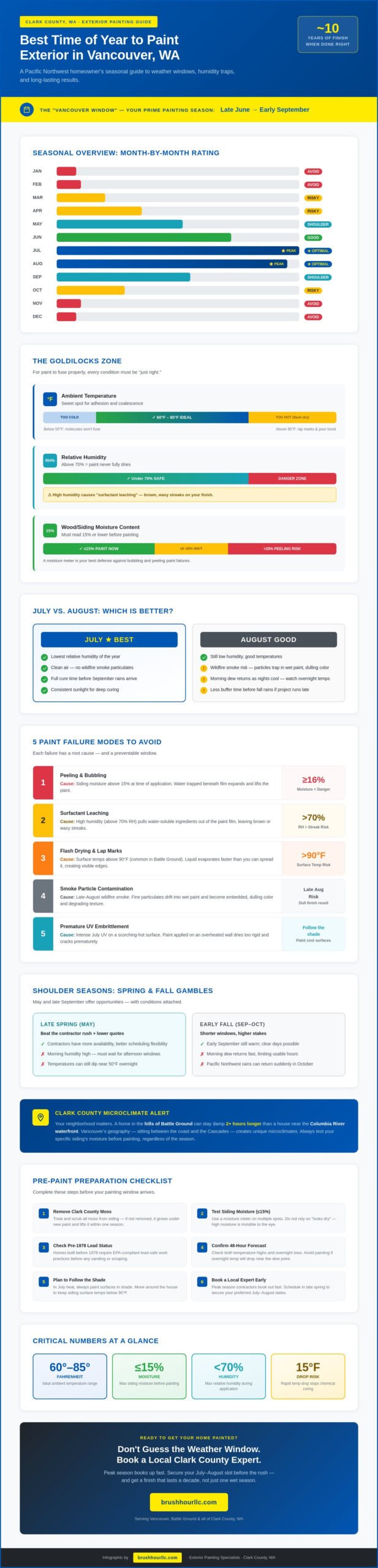
Ever wonder why your neighbor’s paint job looks fresh for years while others start peeling after one winter? It usually comes down to the calendar. In Clark County, we work within what we call the “Vancouver Window.” This prime period typically spans from late June through early September. During these months, the weather finally cooperates with the chemistry of the paint. Choosing the best time of year to paint exterior in Vancouver WA isn’t just about avoiding a downpour; it’s about finding the right atmospheric conditions for a long-term bond.
Why is this specific timeframe so critical? It’s all about the “Goldilocks zone.” For the best adhesion, you want ambient temperatures between 60°F and 85°F. If it’s too cold, the paint molecules won’t fuse together. If it’s too hot, the liquid evaporates before it can grip the siding. You also need to watch those overnight lows. If the temperature drops too close to the dew point, moisture settles on the wet film and causes “surfactant leaching,” which ruins the finish. Our local geography plays a huge role here too. If you check the Vancouver, WA climate details, you’ll see how our position between the coast and the Cascades creates unique microclimates. A home in the hills of Battle Ground might stay damp two hours longer than a house near the Columbia River waterfront.
The July and August Sweet Spot
Why do we circle July and August on our calendars? These months offer the lowest relative humidity in the Pacific Northwest. Low humidity allows the water in high-quality acrylic paints to evaporate at a steady, predictable rate. This process is how paint molecules fuse into a durable shield that resists our winter storms. Consistent sunlight also helps deep-cure architectural-grade coatings. Just be careful when the thermometer hits 90°F. In areas like Battle Ground, extreme heat can cause “flash drying.” This leads to visible lap marks and poor bonding. We always recommend following the shade around the house to keep the siding surface cool during application.
Why Early Summer is Often Better Than Late Summer
Is it better to wait until the end of the season? Not necessarily. Early summer often provides a cleaner environment for your house painting project. By late August, we frequently deal with wildfire smoke. These fine particulates can drift into your wet paint and get trapped, dulling the color and texture. You also have to fight the returning “morning dew” as nights begin to cool in late August. Getting your project done in July ensures everything is cured and hard before the first unpredictable September rains arrive. Don’t let the return of the rain catch your home unprotected.
The Science of the PNW Climate: Why Temperature and Humidity Rule
Why does the weather matter so much? It’s all about how paint works at a molecular level. Most people think paint just “dries,” but the real magic is a process called coalescence. This is when paint molecules fuse together into a single, protective layer as water evaporates. Understanding this chemistry is the secret to identifying the best time of year to paint exterior in Vancouver WA. If the conditions aren’t right, those molecules never quite link up. This leaves your home vulnerable to the next big storm.
What happens when the air is too heavy with water? You hit the “Relative Humidity Trap.” Once humidity climbs above 70%, the air simply can’t accept more water vapor. This stops the paint from ever truly drying. You might also notice surfactant leaching, which shows up as brown, waxy streaks. This occurs when moisture pulls essential ingredients out of the paint film before it can set properly. Even the sun can be a threat. Intense July UV rays can embrittle paint if it’s applied on a scorching surface. This causes it to crack much sooner than it should.
The Impact of PNW Humidity
Vancouver’s morning fog is a secret enemy to exterior house painters. It leaves a micro-layer of moisture on your siding that’s hard to see but easy to feel. These high moisture levels prevent water from escaping the paint film. This is why a wall can feel “dry to the touch” but remain soft and vulnerable underneath for days. Before we dive into the curing process, we always ensure that any home built before 1978 is handled with lead-safe work practices to keep your property safe and compliant.
Temperature Fluctuations in Clark County
Watch out for the “15-degree drop.” In Battle Ground, the temperature can plummet quickly as soon as the sun dips behind the trees. If the surface temperature falls too fast, the chemical reaction stops in its tracks. We also avoid working in direct, scorching 95°F sunlight on south-facing walls because the heat can cause the paint to blister. The glass transition temperature is the point below which paint fails to form a flexible, protective film. If you’re unsure about your home’s specific microclimate, reaching out to a residential painter who knows Clark County can save you a lot of stress.
Navigating the Shoulder Seasons: Is Spring or Fall a Gamble?
Ever feel like you’re playing weather roulette? In the Pacific Northwest, the “shoulder seasons” of late spring and early fall are the ultimate gamble for homeowners. You might see a week of glorious sunshine in May and assume it’s the best time of year to paint exterior in Vancouver WA. We call this the “May Mirage.” While the air feels warm and the grass is finally drying out, your home’s siding has likely spent the last six months soaking up relentless Clark County rain. Even if it looks dry on the surface, moisture is often trapped deep within the wood fibers or tucked behind the lap siding.
Painting over that trapped moisture is a recipe for a costly headache. As the summer sun eventually heats the house, that water turns into vapor and pushes against the new paint film, causing bubbles and peeling. We also have to watch out for moss and mildew spores. In the spring, these spores are extremely active and airborne. If they land on tacky, fresh paint, they can become a permanent, unsightly part of your home’s new finish. It’s a risk that requires a professional eye to manage.
The Pros and Cons of Spring Painting
Why consider spring at all if it’s so risky? The biggest advantage is beating the summer rush. By booking early, you have a much better chance of securing residential painting near me before the top-rated contractors are booked through September. However, you must be patient with the schedule. We look for a strict three-day “dry window” where the siding can fully off-gas moisture before we even open a can of paint. If we don’t get that specific window, we wait. Your home’s long-term protection is more important than a fast start.
The Fall Painting Window
What about the other end of the season? Early September is often the hidden gem of the local painting season. The ground is dry, the siding is at its lowest moisture content of the year, and the air is still warm. But you have to move fast to beat the “Big Dark” rains that return in October. The danger here is “trapped heat.” If we paint a west-facing wall that’s been baking in the sun all day and the temperature drops 20 degrees at night, the paint can’t cure evenly.
Thankfully, modern technology helps us extend these windows safely. We often use specialized “Low-Temp” paint formulas that allow for application down to 35°F, provided we follow specific precautions regarding dew points. How do you know if it’s truly too late in the year? If the daytime highs struggle to reach 45°F or if the forecast shows consistent rain for more than 48 hours, it’s time to pause. We’d rather help you wait for the best time of year to paint exterior in Vancouver WA than see you deal with a failed finish that lasts only a season.
How to Prepare Your Home for the Perfect Painting Window
Ready to get started? Picking the best time of year to paint exterior in Vancouver WA is only half the battle. Even if you land the perfect week in July, your new finish will only be as good as the preparation underneath it. In the Pacific Northwest, our homes take a beating from moisture, moss, and temperature swings. If you skip the prep work, you are essentially painting over a ticking time bomb. How do we ensure your home is actually ready for its transformation?
- Step 1: The “Deep Clean.” We start by removing stubborn Vancouver moss and algae. We don’t just use water; we apply eco-friendly antimicrobials that kill spores at the root so they don’t grow back under your new paint.
- Step 2: The “Dry Out.” This is where patience pays off. After cleaning, we wait. We use professional tools to ensure the siding isn’t just dry on the surface, but dry all the way through.
- Step 3: Scraping and Sanding. To achieve professional wall painting results, we remove every flake of loose material. A smooth substrate is the only way to get that “like-new” look.
- Step 4: Strategic Caulking. We seal every gap where PNW rain loves to hide. This keeps moisture from getting behind your siding during our long, wet winters.
The Essential Moisture Meter Test
Why isn’t “looking dry” good enough? Many homeowners rely on the touch test, but a professional painting contractor knows that appearances are deceiving. Wood siding, especially the cedar common in Clark County, acts like a sponge. If we paint over wood that feels dry but is still damp inside, the summer sun will turn that moisture into steam. This leads to “blistering,” where the paint bubbles and pops off the wall. A professional moisture meter reading above 15% is a red light for any exterior painting project in the Pacific Northwest. We never ignore the data because we want your home to stay protected for years.
Managing Moss and Mildew Pre-Painting
Do you live on one of Battle Ground’s beautiful wooded lots? The shade from those trees creates a perfect breeding ground for mildew. We use specialized fungicidal washes to treat these areas before we ever pick up a brush. It’s a delicate balance. There is a big difference between “pressure washing” and “destructive washing” on aged siding. We avoid high-pressure settings that can gouge the wood or force water deep into your wall cavities. This careful approach also prevents “tannin bleed” in cedar siding, ensuring your light colors stay bright and don’t turn yellow or brown after a deep cleaning. If you want to make sure your prep is handled by a pro, reach out to a local house painter today to get a head start on your project.
Choosing a Local Expert to Master the Clark County Climate
Why does local experience matter so much? It’s because we live in the same rain we paint in. From the waterfront in Vancouver to the wooded hills of Battle Ground, our team at Brush Hour LLC understands the specific challenges of our local climate. Even when you’ve identified the best time of year to paint exterior in Vancouver WA, Mother Nature can still throw a curveball. That’s why we utilize “Rain-Ready” technology like Sherwin-Williams Latitude. This advanced coating is a game-changer for our clients because it develops moisture resistance in a fraction of the time required by standard paints. It allows us to maximize those narrow weather windows without compromising the quality of your finish.
We also take schedule management seriously. We know the anxiety of seeing your home’s siding exposed while dark clouds gather on the horizon. We never leave a house “naked” during a storm. By using industrial-grade weather tracking software, we coordinate our prep and application phases to ensure every layer is cured before the rain returns. This methodical approach is backed by a localized warranty. Unlike generic corporate guarantees, our protection plan is built to withstand the specific stresses of the Pacific Northwest, from our humid mornings to our freeze-thaw cycles.
The Professional Equipment Advantage
How do we ensure the paint actually stays put? It’s about more than just a brush and a bucket. We use high-build sprayers combined with a technique called back-rolling. This process manually forces the paint into the wood grain or masonry pores, creating a bond that a sprayer alone cannot achieve. Our team also relies on the moisture detection tools we discussed earlier to verify the 15% threshold before every project. We prioritize 100% acrylic systems because they offer the superior flexibility needed to expand and contract with your home as the seasons change.
Ready to Protect Your Home?
Is your home’s exterior currently vulnerable? A fresh, professional coat of paint acts as your first line of defense against wood rot, pest intrusion, and structural damage. While it might be tempting to wait, the long-term ROI of using premium materials during the peak summer window is undeniable. You’ll save money by avoiding premature repaints and costly siding repairs down the road. Are you ready to see your home transformed? Our summer calendar fills up quickly as the weather clears. Reach out for a local estimate today and let’s ensure your home is protected for the next decade, not just the next season.
Ready to Revitalize Your Home’s Exterior?
Are you ready to give your home the protection it deserves? We’ve explored why the window from late June through early September offers the most reliable weather for a lasting finish. You now know that moisture testing and professional cleaning are non-negotiable steps for a durable result. Finding the best time of year to paint exterior in Vancouver WA is about more than just dodging rain; it’s about matching the right chemistry with the perfect timing.
Since 2012, we’ve specialized in moisture-resistant exterior coatings designed for our unique Pacific Northwest environment. As a licensed and insured house painter in Washington State, we understand the specific microclimates of Vancouver and Battle Ground better than anyone. We’re here to help you navigate the clouds and deliver a transformation you’ll be proud of for years. Get Your Free Exterior Painting Estimate from Brush Hour LLC today. Let’s make your home the standout of the neighborhood before the summer season slips away.
Frequently Asked Questions
What is the best month to paint a house in Vancouver, WA?
July is the absolute best month because it offers the most consistent dry window and lowest humidity levels in Clark County. August is a close second, though you have to watch out for higher heat and potential wildfire smoke particulates. These months represent the best time of year to paint exterior in Vancouver WA for maximum paint adhesion and long-term durability.
Can you paint a house if the forecast says it might rain later that day?
It’s usually a bad idea if rain is expected within four to six hours of application. Most high-quality acrylic paints need a solid block of dry time to form a skin. If a surprise shower hits too soon, you risk surfactant leaching, which leaves unsightly waxy streaks on your new finish. We always monitor the local radar to ensure your home stays protected.
How long should I wait to paint after it rains in the PNW?
Wait at least 24 to 48 hours after a heavy rainfall before applying any coatings. While the surface might look dry, wood fibers act like sponges and retain moisture deep inside. Painting too soon traps that water, leading to bubbles and peeling as soon as the sun comes out. Patience is the secret to a professional-grade finish that lasts.
Is it better to paint in the spring or the fall in Clark County?
Early fall is typically the hidden gem for painting projects in our area. Spring siding is often still saturated from months of winter rain, making it harder to reach that safe 15% moisture threshold. September offers dry siding and mild temperatures, providing a much safer environment for the paint to cure properly before the winter rains return.
What happens if you paint a house when the humidity is too high?
High humidity prevents the water in the paint from evaporating, which stops the curing process in its tracks. If the relative humidity is above 70%, the paint stays tacky for too long, attracting dust, pollen, and mildew spores. In extreme cases, the paint molecules never fully fuse, leaving you with a finish that fails within just a few seasons.
Do I really need to use a moisture meter before painting my siding?
Yes, a moisture meter is your best defense against a failed paint job. Guessing by touch isn’t reliable because wood can feel dry on the outside while remaining damp at the core. We never start a project until the meter confirms a reading of 15% or lower. It’s the only way to guarantee the paint will actually bond to the substrate.
Should I use a flat or satin finish for a home in a rainy climate?
Satin is the superior choice for the Pacific Northwest because its slight sheen helps shed water more effectively than flat paint. This moisture resistance makes it much harder for moss and mildew to take hold on your siding. Satin finishes are also easier to clean, which is a huge plus when dealing with the inevitable winter grime in Vancouver.
How long does a professional exterior paint job last in Vancouver, WA?
A high-quality, professional job should last between 7 and 10 years in our climate. This longevity depends entirely on the preparation work and the weather conditions during application. By choosing the best time of year to paint exterior in Vancouver WA and using premium 100% acrylic paints, you ensure your home stays beautiful and protected for a decade.