
What if the most expensive part of your painting quote is actually the work you can’t see once the brushes are put away? It’s a common worry for homeowners in our corner of Clark County. You look at your siding and see that familiar green moss creeping back, or perhaps you’ve noticed tiny cracks where moisture is already starting its work. You want your home to look fresh and revitalized, but the wide range in the cost to paint house exterior Battle Ground estimates can leave you feeling more confused than confident.
It’s completely normal to feel overwhelmed by differing bids and the fear that a new coat might start peeling in just a couple of years. You deserve a finish that doesn’t just look good on day one, but stays beautiful for a decade. This guide will show you how professional preparation drives the real value and longevity of your project in our damp PNW climate. We’ll explore the essential steps to seal your home against rot, explain why prep is the ultimate moisture management tool, and give you a clear framework to evaluate every quote you receive with total peace of mind.
Key Takeaways
- Understand why thorough preparation is the essential foundation for paint adhesion and structural integrity in the damp Pacific Northwest climate.
- Discover the 5-step professional prep process designed to eliminate moss spores and prevent paint from peeling prematurely.
- Learn how to evaluate the cost to paint house exterior Battle Ground quotes by looking for specific labor hours dedicated to mechanical scraping and sanding.
- Identify siding-specific needs, such as managing tannin bleed on natural cedar or ensuring joint integrity on fiber cement boards.
- Avoid the number one cause of paint failure in Clark County by learning how to properly time your project around local moisture and drying windows.
Why Exterior Painting Prep Drives the Cost in Battle Ground
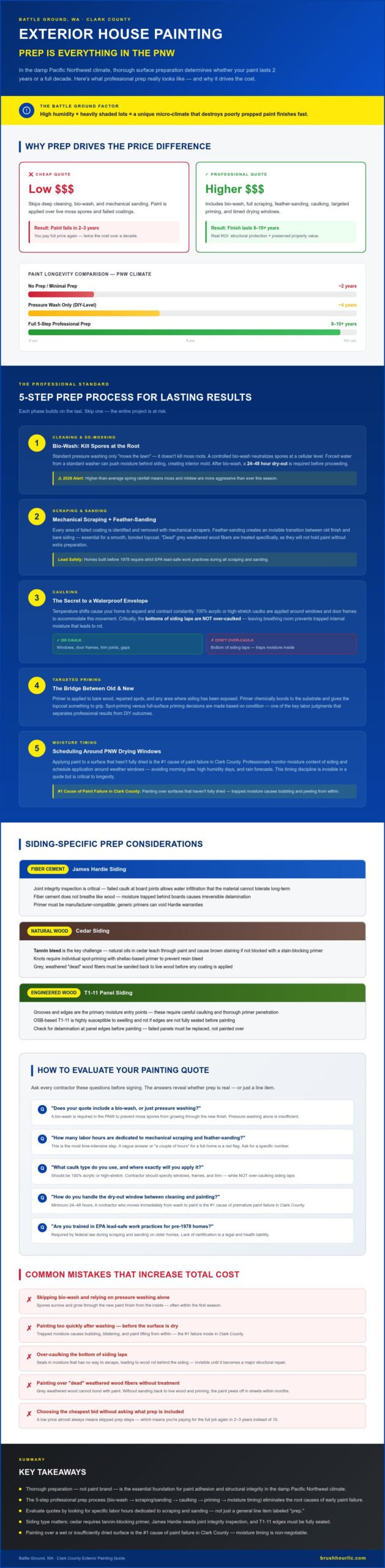
Ever wonder why one quote is double the price of another? It usually comes down to what happens before the first gallon of paint is even opened. In our region, the cost to paint house exterior Battle Ground projects is largely determined by surface preparation. Think of prep as the chemical foundation for your paint’s adhesion. Without it, you are just layering expensive liquid over a crumbling surface. It doesn’t matter how premium the paint is if the surface underneath isn’t ready to receive it.
We call this the “Battle Ground Factor.” Our high humidity and heavily shaded lots create a unique micro-climate for your siding. When contractors skip the deep cleaning or sanding, they leave behind moisture traps. These are tiny pockets of dampness or microscopic debris that eventually cause the paint to bubble and lift. Skipping these steps is the most expensive mistake a homeowner can make. Why? Because you will likely be paying to do the entire job again in just a few years.
The Biology of Battle Ground Moss and Mildew
Walk around any neighborhood in Clark County and look at the north-facing walls. What do you see? It’s almost always a fuzzy green layer of moss or dark streaks of mildew. Standard pressure washing isn’t enough to stop this growth. Pressure alone just “mows the lawn” without killing the roots. We use specialized bio-washes to neutralize spores at a cellular level, a technique also utilized by Atlas Exterior Solutions LLC to ensure a deep clean without damaging surfaces. With 2026 showing higher-than-average spring rainfall, these contaminants are more aggressive than ever. If you don’t treat the biology of the wall, those spores will simply grow through your new finish from the inside out.
Protection vs. Aesthetics: The Real ROI
While everyone loves a fresh color, the real goal is structural integrity. Professional prep prevents wood rot and siding failure by sealing the envelope of your home. This is a core part of professional painting and decorating, where the focus shifts from just aesthetics to long-term preservation. Investing in high-quality prep maintains your property value and ensures your siding lasts its full intended lifespan. A cheap job fails fast in the PNW because it ignores the chemistry of our climate. Don’t settle for a temporary fix. You want a decade of protection that stands up to the rain.
- Prep creates a clean, dry surface for maximum paint bonding.
- Bio-washes kill the roots of moss that pressure washing misses.
- Proper sealing prevents moisture from rotting your home’s substrate.
The 5-Step Professional Prep Process for Lasting Results
When you evaluate the cost to paint house exterior Battle Ground, the bulk of your investment goes into these five critical steps. Professional results require a methodical approach. It isn’t just about speed; it’s about precision. Each phase builds upon the last to ensure the final coat sticks for the long haul. If any step is rushed, the entire project is at risk of failure within just a few seasons.
Cleaning and De-mossing Techniques
Once the siding is dry, we identify every area where the old coating has failed. We use mechanical scraping to remove loose paint, followed by feather-sanding to create an invisible transition between the old finish and the bare siding. For homes built before 1978, we strictly adhere to lead-safe work practices to protect your family and our crew. We also look for “dead” wood fibers, which are grey, weathered wood that won’t hold paint without specific treatment.
Caulking: The Secret to a Waterproof Home
In Battle Ground, temperature shifts cause your home to expand and contract. We use 100% acrylic or high-stretch caulks around windows and door frames to accommodate this movement. However, we avoid “over-caulking” the bottom of siding laps. This allows the house to breathe and prevents internal moisture from being trapped behind the boards. Proper caulking is a major factor in the total cost to paint house exterior Battle Ground, as it requires a steady hand and hours of detailed labor.
Targeted priming is the bridge between the old surface and new paint. We prime bare wood and repaired spots to ensure a uniform sheen across the entire house. Finally, masking protects your roof, windows, and walkways from overspray. This keeps the job site organized and your property clean. If you want to see how these steps look in action on a local project, you can learn more about our exterior painting process.
Siding-Specific Prep: James Hardie, Cedar, and T1-11
Does your home have original cedar or modern fiber cement? The material on your walls dictates the specific labor required, which directly impacts the cost to paint house exterior Battle Ground projects. Each siding type has a “weak point” where PNW weather likes to strike. Understanding these nuances helps you see why a one-size-fits-all bid usually leads to trouble. Different surfaces require different tools and primers to ensure the finish doesn’t just look good, but actually protects the structure.
Preparing Fiber Cement Siding
James Hardie boards are incredibly popular in Clark County for their fire resistance and durability. However, they require a gentle touch during the cleaning phase. We focus on removing surface grime without saturating the concrete-based core. If water gets trapped behind the boards during a high-pressure wash, it can lead to hidden mold. We also carefully inspect the joint integrity. If the original installation left gaps or unprimed cut edges, we seal them to prevent water absorption that causes the boards to swell and crumble over time.
Revitalizing Natural Wood and Cedar
Many older Battle Ground homes feature beautiful natural cedar. Has your siding turned a dusty gray color? That’s UV exposure at work. As mentioned in our discussion on surface integrity, those gray fibers are technically “dead” wood that cannot bond with paint. We sand these areas back to reach healthy, live wood. Once the surface is prepped, we use specialized primers to manage tannin bleed. Tannins are natural oils in cedar that can seep through standard paint, causing brownish-yellow stains. Proper blocking ensures your light colors stay bright for years.
T1-11 siding is another PNW staple, but it’s notorious for rot at the bottom edges. These edges act like a sponge, wicking up moisture from the ground or splash-back from your driveway. We treat these areas with extra sealant to stop rot before it starts. Vinyl siding presents a different challenge: chalking. This is a fine, white powder that develops as the vinyl breaks down in the sun. If this isn’t removed with a dedicated cleaning solution, your new coating won’t have a chance to stick. Addressing these specific siding needs is how we ensure your home stays sealed against the elements.
- James Hardie: Focus on joint sealing and preventing core saturation.
- Cedar: Sanding away UV damage and blocking tannin stains.
- T1-11: Protecting vulnerable bottom edges from moisture wicking.
- Vinyl: Removing oxidation and chalking for a smooth bond.
Common Mistakes That Increase the Cost of Painting
Ever wonder why some homes in our neighborhood start peeling just two years after a fresh coat? It’s usually not the paint’s fault. In fact, the true cost to paint house exterior Battle Ground projects often skyrockets when basic errors are made during the initial application. Fixing a failed paint job is significantly more labor-intensive than doing it right the first time. If you want to avoid paying twice, you need to watch out for these common shortcuts that contractors sometimes take to save time.
The Danger of Rushing the Drying Phase
Did you know that painting over damp wood is the leading cause of failure in Clark County? Our 2026 spring and fall seasons have been notoriously unpredictable. We don’t just guess if your siding is dry; we use professional moisture meters to verify the surface readiness. If the moisture content is too high, the paint won’t bond. It’s that simple. Expert timing is required to paint between the rains without trapping water behind the film. When moisture is trapped, you’ll see blistering or large sheets of paint peeling off down to the bare wood. It’s a mess that’s entirely preventable with a little patience and the right tools.
Inadequate Surface Etching
Is your old paint still glossy? If so, a new layer won’t have anything to grab onto. We perform a simple tape test to check if the existing layer is still firmly adhered. If it fails, that old paint has to come off. For surfaces that are still sound but shiny, we scuff the surface to create a profile. This is where primer acts as the essential bridge for professional wall painting. Without that bridge, the new paint is just sitting on top, waiting for a temperature shift to make it crack and flake away.
Other costly mistakes include using low-grade caulk. Cheap caulk is brittle. After one cold Battle Ground winter, it will crack, allowing water to seep into your trim and cause rot. We also look for chalky residue on your old paint. If you rub your hand across the siding and see a white powder, that’s oxidation. Painting over that powder is like painting over dust; the new coat will eventually just slide off. By avoiding these pitfalls, you ensure your investment lasts a decade rather than just a few seasons. Ready to get it done right the first time? Contact us at Brush Hour LLC for a detailed evaluation of your home’s needs.
- Moisture Meters: We verify siding is dry before any paint is applied.
- High-Stretch Caulk: We only use materials that move with your home.
- Chalk Removal: Every surface is cleaned to ensure a chemical bond.
- Primer Bridge: Essential for transitions between old paint and new coatings.
Evaluating Your Battle Ground Painting Quote
You have collected a few bids for your home, but how do you know which one offers the best value? The total cost to paint house exterior Battle Ground projects can vary significantly between contractors, and the reason usually hides in the fine print. Specifically, you need to scrutinize the “Prep Clause.” Does the quote clearly outline the steps we’ve discussed, or does it simply say “prep as needed”? A vague quote is a red flag that essential labor might be skipped once the work begins.
Why does the lowest bid often lead to the most frustration? It’s simple: labor accounts for 70% to 85% of a professional painting project. Prep work, like the mechanical scraping and feather-sanding mentioned earlier, is the most labor-intensive part of the job. If a quote is surprisingly low, the contractor is likely cutting hours from these foundational steps. You might save money today, but you’ll be paying for a full repaint much sooner than you expected when the finish begins to fail.
Comparing Bids: Apples to Apples
When you sit down to compare your options, use a structured approach to ensure you aren’t missing critical details. Ask yourself these questions about each proposal:
- Does the quote specify the number of labor hours dedicated to surface preparation?
- Are the exact brands and premium lines of paint and caulk listed by name?
- Is there a written plan for protecting your windows, roof, and local Battle Ground landscaping?
- Does the contractor include a deep cleaning or bio-wash in the initial phase?
If these details are missing, don’t be afraid to ask for clarification. A “helpful local expert” will be happy to explain their process and why certain steps are necessary for your specific siding type. Clarity in the quote suggests clarity and organization on the job site.
Why Local Expertise Matters
Hiring a licensed and insured painting contractor in Washington is about more than just following the law. It’s about protecting your home with someone who understands our unique Clark County climate. As experienced exterior house painters, we know how 2026 weather trends affect drying times and paint adhesion. We don’t just guess; we use local knowledge to time your project perfectly.
At Brush Hour LLC, we’re committed to making every home “prep-perfect.” We believe in neighborly, professional service that prioritizes the structural integrity of your siding. We communicate the status of your prep work throughout the project, ensuring you feel confident that your home is sealed against rot. Ready to see the difference that professional preparation makes? We’re here to guide you through the process with a methodical, step-by-step approach that guarantees a beautiful, lasting transformation.
Protect Your Home for the Next Decade
You now have the tools to see beyond a simple price tag. You’ve learned that the true cost to paint house exterior Battle Ground projects is actually an investment in your home’s structural integrity. By focusing on thorough bio-washes, mechanical scraping, and siding-specific primers, you aren’t just changing a color; you’re building a shield against the PNW elements. Remember that a detailed quote reflecting these essential labor hours is your best defense against premature peeling and wood rot.
Don’t let the fear of moisture or confusing bids hold you back from the transformation your home deserves. As a licensed and insured Washington contractor, we take pride in our expert local knowledge of Battle Ground siding and our dedication to precision craftsmanship. We are here to ensure your project is handled with the care and organization of a helpful local expert. We’ll walk you through every step of the process so you feel confident in the longevity of your new finish.
We look forward to helping you revitalize your home with a finish that stays beautiful and sealed for years to come. Your home is your biggest investment, and we are here to help you protect it. Let’s get started on your project together today.
Frequently Asked Questions
How long does the prep process take for a standard Battle Ground home?
Preparation usually takes two to three full days for a standard 2,000 square foot home. This timeline includes the initial bio-wash, a mandatory dry-out period, and the labor-intensive hours spent scraping and sanding. If your home has significant peeling or older cedar siding, this phase might extend to four days. We never rush this stage because the foundation determines the longevity of the entire project. It is the most critical part of the timeline.
Can I do the prep work myself to save money on a professional job?
While you can handle some basic cleaning, most professional painters prefer to manage the prep themselves to guarantee the results. If the prep isn’t done to a specific standard, the final coat may fail, and a contractor cannot warranty work they didn’t perform. Doing your own prep often doesn’t lower the cost to paint house exterior Battle Ground as much as expected because we still must verify every inch for moisture and adhesion.
What happens if it rains immediately after the house is pressure washed?
Rain after a wash isn’t a disaster, but it does reset the clock on your drying time. We use moisture meters to check the siding before any primer or paint is applied. If it rains, we simply wait for the next dry window to ensure the substrate’s moisture level is below 15 percent. Our team monitors local 2026 weather patterns closely to avoid scheduling coating work during active rainfall or periods of high humidity.
How do I know if my siding needs replacement instead of just paint?
Look for soft spots, crumbling edges, or boards that feel spongy when pressed. If the wood is physically disintegrating or has deep-seated rot, paint won’t fix the problem. We inspect your siding during the estimate phase to identify these issues. While painting is much more affordable than new siding, applying it over failed material is a waste of money. We’ll always give you an honest assessment of your home’s structural integrity before we begin.
Is pressure washing enough to remove all the moss from my walls?
No, pressure alone usually fails to kill the microscopic spores that hide in the wood grain. High pressure can also damage your siding by gouging the wood or forcing water behind the boards. We use a specialized bio-wash solution that neutralizes the moss and mildew at the root. This chemical treatment is the only way to ensure the green growth doesn’t return and push through your new paint film within a few months.
What kind of primer is best for the Pacific Northwest climate?
The best primer depends on your siding material. For cedar, we use high-quality oil-based primers to block tannin staining. For fiber cement or previously painted surfaces in good condition, a premium 100 percent acrylic bonding primer is often the right choice. These products are designed to remain flexible during the temperature shifts common in Clark County. Choosing the right bridge between the siding and the paint is essential for a durable finish.
Do you include caulking and minor repairs in your exterior painting prep?
Yes, we include strategic caulking and minor surface repairs as standard parts of our prep process. We focus on sealing gaps around windows, door frames, and trim joints to prevent water intrusion. If we find more extensive rot that requires board replacement, we’ll discuss those options with you before moving forward. This comprehensive approach is a key factor in the total cost to paint house exterior Battle Ground and ensures your home stays waterproof.
Why is my exterior paint peeling even though it was painted recently?
Peeling usually happens because of trapped moisture or poor surface adhesion. If the previous painter didn’t use a moisture meter or skipped the sanding phase, the paint never truly bonded to the siding. In our damp climate, even premium paint will fail if the surface was dirty, chalky, or damp during application. We specialize in diagnosing these failures and correcting the underlying prep issues to ensure your next paint job lasts for a decade.