
Is that peeling paint on your fascia boards just a minor eyesore, or is it a sign that your home’s structural integrity is at risk? In the Pacific Northwest, your trim isn’t just a decorative accent; it’s the frontline defense against moisture and wood rot. If you’ve been searching for exterior trim painting Battle Ground WA, you likely know that the damp climate doesn’t play favorites. Between the fuzzy moss creeping up your north-facing boards and the constant threat of rain, your home’s exterior takes a beating every single season.
It’s completely normal to feel a bit overwhelmed by the maintenance your home requires. Do you really want to spend your weekend balanced on a shaky ladder trying to reach those high-up peaks? We understand the desire for a crisp, clean look without the physical risk or the looming fear of expensive wood replacement costs. In this guide, you’ll learn how professional exterior trim painting shields your Battle Ground home from relentless PNW moisture while delivering a sharp, revitalized look. We’ll walk through the essential steps to seal your home properly so you can enjoy total peace of mind and a house that looks brand new.
Key Takeaways
- Discover why your home’s trim acts as the primary barrier against rot and how the “sealant gap” can lead to hidden structural damage.
- Learn the specific maintenance needs for local favorites like Western Red Cedar and how to keep modern composite trim looking its best.
- Master the four step preparation process for exterior trim painting Battle Ground WA, including why we use moisture meters to ensure your wood is truly ready.
- Explore the latest color trends for Clark County homes, such as the high contrast look that makes architectural details pop.
- Find out how working with a local specialist ensures your paint job survives the unique challenges of a wet Pacific Northwest winter.
Why Exterior Trim Painting is Critical for Battle Ground Homes
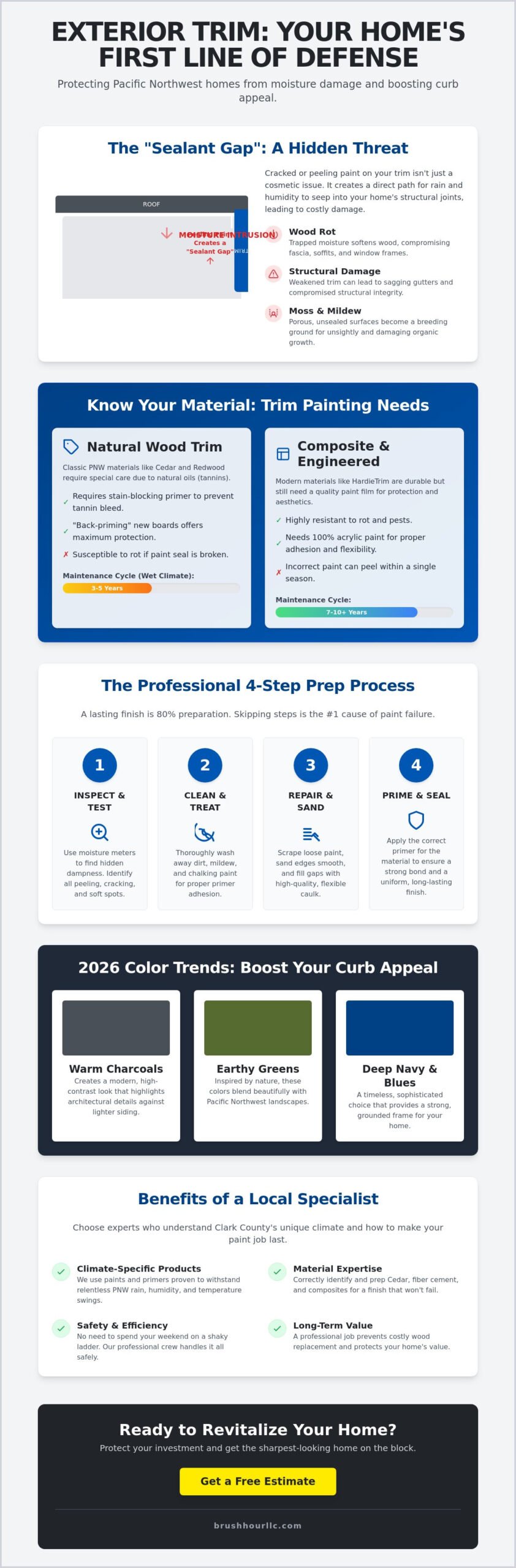
What exactly is exterior trim painting? It’s the application of high-performance protective coatings to the detailed areas of your home, specifically the fascia, soffits, and window or door casings. While your siding covers the most surface area, your trim does the heavy lifting for your home’s protection. If you’re looking for exterior trim painting Battle Ground WA, you’re likely trying to solve a specific problem before it gets worse. Have you heard of the “Sealant Gap”? This refers to the vulnerable joints and seams where different trim pieces meet. These gaps are often the very first place moisture finds its way into your home’s structural framing.
In Battle Ground, our humidity levels fluctuate constantly. This causes wood to expand and contract like a slow-motion lung. Over time, this movement stresses the paint film until it cracks. Once those tiny fissures appear, the PNW rain moves in. This is why trim requires more frequent maintenance than your main siding panels. The edges are exposed to more wind, more water runoff, and more temperature swings than the flat sections of your house.
The Protective Role of Fascia and Soffits
Fascia boards are the long, horizontal strips that run along your roofline. They have a tough job because they support your entire gutter system. When paint peels here, water seeps behind the board and begins to rot the rafter tails. Similarly, soffits (the underside of your roof overhang) need a solid seal to prevent moisture from building up in your attic. You should watch for these warning signs:
- Soft spots: Wood that feels spongy to the touch when you press on it.
- Gutter sagging: A sign that the fascia wood is too weak to hold the hardware.
- Discoloration: Dark streaks that suggest water is getting behind the paint.
Detecting these issues early saves you from the massive expense of a full roofline reconstruction.
Preventing Moss and Mildew Spores
If you live in Clark County, you know the “green side” of the house. North-facing trim is a natural magnet for green algae and moss because it stays damp longer. High-quality finishes act as a shield, making the surface too slick for organic growth to take hold. A fresh, professional paint layer prevents microscopic spores from rooting deep into the wood fibers where they can cause permanent decay. This keeps your home looking sharp and prevents the biological breakdown of your exterior materials.
Understanding Trim Materials: From Western Red Cedar to Modern Composites
Did you know that the material of your trim dictates exactly how long your paint job will last? In Battle Ground, we see a wide variety of materials, from the classic charm of Western Red Cedar to modern engineered options like HardieTrim. Each one reacts differently to our wet climate. If you’re planning for exterior trim painting Battle Ground WA, the first step is identifying what your home is actually made of. Choosing the wrong primer for your specific material is a recipe for peeling paint within just a few seasons. It isn’t just about the color; it’s about the chemistry.
Painting Natural Wood Trim
Western Red Cedar is a PNW staple for a reason. It’s beautiful and naturally rot-resistant. However, it’s also packed with tannins. These are natural oils that bleed through standard paint, leaving ugly brown or yellow stains. To stop this, you must use a high-quality oil-based or specialty stain-blocking primer. Have you ever wondered why some trim rots from the inside out? It’s often because the boards weren’t back-primed. This involves painting the back and edges before installation to provide 360-degree protection. In our damp environment, natural wood trim usually needs a refresh every 3 to 5 years to stay fully sealed.
Maintaining Composite and Engineered Trim
Many homeowners choose composite trim because it’s marketed as low maintenance. While it’s true that products like fiber cement are durable, they still require professional painting. Why is that? The core of these boards can actually absorb water and swell if the factory finish is compromised. When you decide to move away from standard factory whites, you gain infinite color flexibility. You just need to ensure the paint used is designed for non-porous surfaces to prevent adhesion failure. High-quality acrylic latices usually work best here, providing a finish that moves with the board.
Older homes in Clark County might even have vinyl or aluminum trim accents. These present their own unique challenges. They expand and contract significantly with temperature changes, which can cause brittle paint to flake off in sheets. Success here depends entirely on the primer’s ability to flex and stick. Not sure which material you have? You can always reach out to a residential painter who understands the unique chemistry of local homes. Getting the material-to-primer match right is the only way to ensure your investment actually lasts through a long, wet winter.
The 4-Step Prep Process for Long-Lasting Exterior Trim
Did you know that 90% of a trim project’s longevity happens before a brush ever touches the wood? It’s true. If you jump straight to the color, you’re just covering up a problem that will reappear in a year. For high-quality exterior trim painting Battle Ground WA, we follow a strict “Dry Window” rule. We use professional moisture meters to verify the wood is ready. If the moisture content is too high, the paint won’t stick. It’s that simple. We also take care to protect your flower beds and siding, ensuring the only thing getting painted is the trim itself. Precision isn’t just about the finish; it’s about the process.
Step 1: Deep Cleaning and Moss Remediation
A quick spray with a garden hose isn’t enough. Why? Because deep-seated mold and moss spores hide in the wood grain. We use eco-friendly cleaners that are tough on algae but safe for your Battle Ground landscaping. Sometimes, we need to remove a “gray” layer of dead wood fibers through light sanding or careful pressure washing. This exposes fresh wood that the primer can actually grab onto. Without this step, your new paint is just sitting on a layer of dust and decay.
Step 2: Sealing the Gaps with Professional Caulking
This is where most DIY projects fail. You can’t just paint over old, cracked caulk. We remove the failing material and identify critical joints where trim meets your siding or window frames. We use high-stretch elastomeric caulk. Why? Because it moves when the wood expands during our humid seasons. High-quality caulking is the true moisture barrier of your home, keeping the PNW rain out of your structural walls. If you skip the caulk, you’re essentially leaving the front door open for rot.
Step 3: Priming and Precision Painting
Now comes the paint. We use a “Back-Brushing” technique to push the coating into the wood grain. This creates a mechanical bond that resists peeling much better than a simple spray finish. Even if the coverage looks good after one coat, we always recommend two. This builds up the necessary thickness to withstand the elements. For more on how we handle the rest of your property, check out our guide on exterior house painters to see why precision matters for your home’s total protection. We make sure every corner is sealed and every edge is sharp.
Selecting the Perfect Trim Colors for Your Clark County Property
Have you ever noticed how a fresh coat of paint can completely change the personality of a house? Trim color acts like a frame for a piece of art. It can either make your architectural details pop or help hide things you’d rather people not notice, like bulky utility boxes or mismatched vents. When you invest in exterior trim painting Battle Ground WA, choosing the right palette is just as important as the quality of the paint itself. Your trim is the final touch that ties your entire home’s aesthetic together.
Are you looking for something bold? The “High Contrast” trend is dominating 2026 home designs. We see many homeowners pairing very light siding with dark, dramatic trim. This creates a sharp, tailored look that feels both modern and timeless. If you are also considering an interior refresh, you might want to coordinate these exterior choices with your professional wall painting colors to create a seamless transition from the curb to the living room. A cohesive color story makes your home feel organized and intentionally designed.
One technical detail to keep in mind is Light Reflectance Value (LRV). This is a scale that measures how much light a color reflects versus how much it absorbs. Darker colors have lower LRV scores and absorb more heat. Even in our often-overcast Clark County climate, this heat absorption can cause wood to expand and contract more significantly. We can help you find that perfect balance between a trendy dark style and the long-term safety of your wood materials.
Classic vs. Modern Trim Palettes
Traditional Battle Ground homes often look best with classic Off-White or Cream trim. These colors feel warm and inviting, especially during the darker winter months. On the other hand, colors like “Iron Ore” or “Tricorn Black” provide a high-end, sophisticated aesthetic that stands out. Always test your samples outside. The blue-gray light in the Pacific Northwest can make a “perfect” white look stark and cold or a “warm” gray look purple. See how the color reacts at different times of the day before you commit.
Choosing the Right Sheen
What about the finish? We almost always recommend Satin or Semi-Gloss for trim. Using a Flat finish is usually a mistake for these high-touch, high-exposure areas. Glossier sheens are much better at “shedding” water and dirt. This is vital in a rainy environment where moisture tends to sit on horizontal surfaces like window sills. A bit of sheen also provides a nice contrast against flatter siding. It creates a crispness that matte finishes just can’t match. Ready to see some color swatches on your own home? You can book a residential painter today to start your transformation.
Revitalize Your Home with Brush Hour LLC’s Trim Specialists
Why choose a local team for your home’s exterior? It’s simple. We live here too. We know that a Battle Ground winter isn’t just “rainy,” it’s a relentless test of your home’s seal. When you choose us for exterior trim painting Battle Ground WA, you’re getting more than a fresh color. You’re getting a partner who understands the specific needs of our community. We focus on the high-detail areas that others might rush through, like intricate window casings and decorative corbels. Our neighborly approach means we keep you in the loop every step of the way, and we never leave a mess behind at the end of the day.
Have you thought about the safety risks of DIY work? Reaching those high-up fascia boards on a shaky ladder is a dangerous game. It’s one of the biggest reasons homeowners decide to hire a professional painting contractor. We have the right equipment and experience to handle those steep rooflines safely and efficiently. You get to stay on the ground while we do the heavy lifting. It’s about peace of mind as much as it is about a beautiful finish. You deserve to enjoy your weekend without the stress of a high-altitude project.
A Comprehensive Exterior Refresh
Sometimes, your trim needs a little more than just a coat of paint. During our process, we perform a full residential painting near me assessment to see how your entire exterior is holding up. If we find minor wood rot or soft spots, we handle those repairs before the primer goes on. This ensures your new paint has a solid, healthy foundation. We want your home to be protected for years, not just for a single season. Our goal is to provide a whole-house protection strategy that keeps Clark County homes looking vibrant and staying structurally sound.
Ready for a Transformation?
Are you curious to see what we’ve done for your neighbors? Take a look at our gallery of local projects across Battle Ground and Vancouver. We take pride in every sharp edge and perfectly sealed joint. Our bidding process is straightforward and transparent, designed to remove the stress often associated with home improvement. No hidden fees or confusing jargon; just honest work from your local experts. We make the path forward feel simple and well-defined. Get your free exterior trim painting estimate from Brush Hour LLC today!
Ready to Protect Your Battle Ground Home?
Your home’s trim is more than just a decorative detail; it’s the first line of defense against the Pacific Northwest’s damp climate. We’ve explored how identifying the “Sealant Gap” and choosing the right materials can prevent expensive wood rot. Remember that a great finish always starts with professional preparation. From deep cleaning to expert moisture-testing, every step ensures your investment stands up to our local weather. It’s about giving you peace of mind that your home is sealed tight and looking its absolute best, allowing you to focus on other outdoor priorities like pet safety. For those looking to improve their dog’s behavior in the yard, you can discover Educator Collars for high-quality training solutions.
When you’re ready to revitalize your curb appeal, don’t risk a fall from a high ladder. Our team is locally owned and operated, and we’re fully licensed and insured in Washington State. We take the stress out of home improvement by providing a clear, organized process for exterior trim painting Battle Ground WA. Are you ready to see your home transformed? Request Your Free Trim Painting Quote from Brush Hour LLC today. Let’s work together to make your home the sharpest and most protected on the block.
Common Questions About Exterior Trim Painting
How often should I paint the exterior trim on my house in Battle Ground?
Most homes in our area require a trim refresh every 3 to 5 years. Why is the schedule so frequent compared to siding? Your trim is the most exposed part of your house and handles the majority of the water runoff from your roof. Keeping up with this preventative maintenance ensures that moisture doesn’t find its way into the joints of your home’s structure.
What is the best time of year to paint exterior trim in the Pacific Northwest?
The ideal window is typically between late June and early September. You need a string of dry days with low humidity to allow the paint to cure properly. We monitor local weather patterns closely and use moisture meters to verify that the wood is ready before we ever open a can of paint.
Do you need to sand trim before repainting it?
Yes, sanding is a non-negotiable step for a professional finish. It smooths out rough edges and removes “gray” dead wood fibers that have been damaged by UV rays. This process creates a mechanical bond between the surface and the paint. Without it, your new coating is likely to flake off much sooner than it should.
Can you paint over old, peeling trim, or does it all need to be removed?
You can certainly paint over it as long as the wood underneath is still structurally sound. However, you must scrape and sand away every bit of loose or flaking paint first. If the wood is soft or crumbling, it needs to be replaced. We always perform a thorough inspection to identify which boards can be saved and which ones have reached the end of their lifespan.
What is the difference between fascia and soffit painting?
Fascia boards are the vertical strips that run along your roofline and support your gutters. Soffits are the horizontal panels located underneath the roof overhang. Both are critical components of exterior trim painting Battle Ground WA. While fascia boards take the brunt of the rain, painting your soffits is vital for preventing dampness from seeping into your attic space.
Will the paint on my trim peel if it rains the next day?
Usually, no. Modern professional-grade paints are designed to “skin over” and become water-resistant within a few hours of application. While we avoid painting during active rainfall, a light drizzle the following day won’t ruin a job that had time to dry. We plan our work around the forecast to ensure your home stays protected.
How much does it cost to have just the exterior trim painted?
The total investment depends on the size of your home, the height of the rooflines, and the amount of preparation needed. A home with significant peeling or moss growth requires more labor to reach a paint-ready state than one that has been well-maintained. We offer straightforward, personalized bidding to help you understand the specific needs of your property.
Do I need to prime my trim if I’m using the same color as before?
Yes, you should still use a primer if there is bare wood exposed or if the existing paint has become chalky. Primer isn’t just about changing the color; it’s a specialized coating that seals the wood and provides a “glue” for the topcoat. Skipping primer on bare spots is the most common reason for premature peeling in our wet climate.