
What if the fading color on your siding isn’t just an eyesore, but a warning that your home’s structural integrity is at risk? Most people think of paint as “makeup” for their property. In reality, it is the primary line of defense against moisture and rot. If you are starting to notice the common signs you need to repaint your house, it means that protective barrier has already begun to fail. It is natural to feel a bit hesitant about the potential cost of a full project. You might even wonder if a simple power wash could buy you another year of peace of mind.
We understand that conflicting advice about painting frequency can feel overwhelming. You want to ensure your siding is safe from the elements without overpaying for work you don’t need yet. That is why we have put together this guide to help you identify paint failure before it turns into an expensive repair. You will learn how to evaluate your home like an expert and understand the long term value of hiring a professional painting contractor. Let’s look at the five clear indicators that your home is ready for a fresh, protective coat.
Key Takeaways
- Understand why your paint is a vital “shield” that prevents moisture from reaching your home’s structural materials.
- Spot the early visual signs you need to repaint your house, such as bubbling or flaking, to avoid the high cost of wood rot.
- Learn how to navigate Vancouver’s specific climate challenges, including the “moss factor” that impacts local siding.
- Stop relying on the “7-year rule” and find out why waiting for visible peeling often means you have waited too long.
- Follow a simple step-by-step audit to evaluate your property’s exterior and determine your next best move.
More Than Just a Color Change: Why Your Paint Matters
Is your home’s exterior just a pretty face? Many homeowners view paint as a purely aesthetic choice. In reality, paint is a sacrificial barrier designed to take the brunt of the weather so your home’s structural materials don’t have to. Whether your house is finished with wood, fiber cement, or drywall, that thin layer of pigment and resin is the only thing standing between your investment and the elements. Is your paint still doing its primary job? If you’re searching for signs you need to repaint your house, you’ve already taken the first step toward protecting your biggest asset.
Think about the alternative for a moment. A fresh coat of paint from a professional painting contractor is a manageable maintenance task. Replacing rotted siding or moisture-damaged structural beams? That is a full-scale construction nightmare. As your helpful local expert, we want to help you catch these issues while they are still surface-level. By understanding the difference between cosmetic fading and actual protective failure, you can save thousands of dollars in the long run.
The Secret Job of Exterior Paint
Exterior paint has a tough life. Its main responsibility is to seal out moisture. When paint cracks or peels, water finds its way into the substrate. This leads to wood rot, swelling, and even mold growth behind your siding. Beyond moisture, paint acts as a sunscreen. UV rays from the sun can make siding materials brittle and prone to cracking over time. Are you waiting for the paint to literally fall off before you act? That might be waiting too long. Once you see common types of paint failure, the underlying material is already exposed to damage.
The Functional Side of Interior Paint
Don’t forget about the inside. Interior paint isn’t just about matching your new sofa; it’s about durability. In high-humidity areas like kitchens and bathrooms, the right paint prevents moisture from seeping into the drywall. High-quality finishes also provide a “washable” surface. This means stains from busy hands or pets can be wiped away without damaging the wall itself. Beyond the practical, there is the feeling of a fresh start. A clean, updated interior reduces the stress of living in a space that feels “worn out.” It’s about peace of mind and pride in your home. When you notice signs you need to repaint your house indoors, it’s usually a signal that your living environment is ready for a revitalization.
The 5 Unmistakable Visual Signs of Paint Failure
How do you tell if your home is actually in trouble? It starts with a close look at the surface. While some wear is normal over time, certain signs you need to repaint your house indicate that the protective layer has been compromised. Catching these early prevents the substrate from absorbing moisture and rotting from the inside out. If you wait until the damage is obvious from the sidewalk, you are likely already facing a higher repair bill.
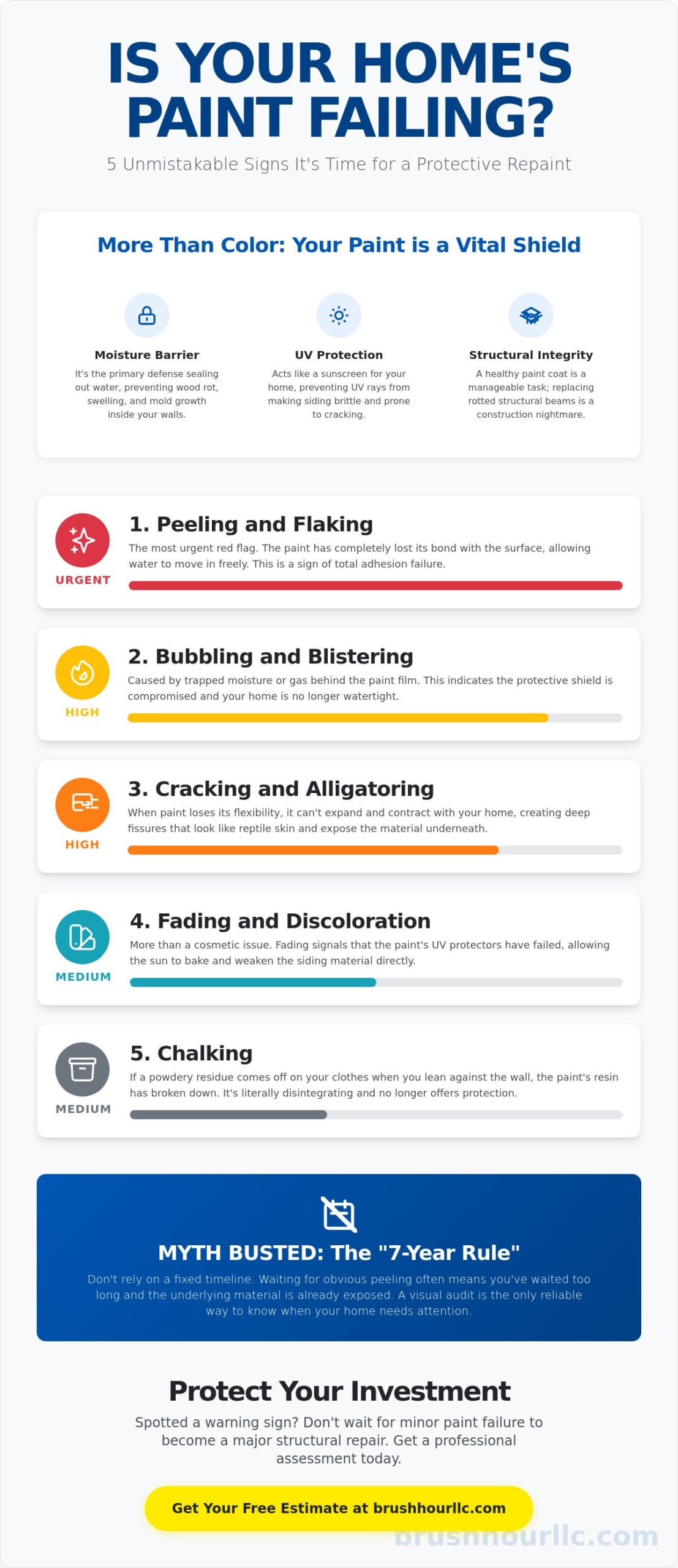
- Peeling and Flaking: This is the most urgent red flag. It means the paint has completely lost its ability to stick to the surface. Once the bond breaks, water moves in freely.
- Bubbling and Blistering: Do you see small bumps or bubbles on the siding? This happens when gas or moisture gets trapped behind the paint “shield.” It is one of the common causes of paint failure that suggest your home is no longer watertight.
- Cracking and Alligatoring: When paint looks like reptile skin, it has lost its flexibility. As your house expands and contracts with the weather, brittle paint simply snaps, creating deep fissures.
- Fading and Discoloration: This is more than a dull look. Fading proves that the UV protectors in the paint have reached their limit. Without these, the sun begins to bake and weaken your siding.
- Chalking: This is the literal disintegration of the paint. If you lean against your house and walk away with a white, powdery residue on your clothes, the resin has failed.
Identifying Peeling vs. Chipping
Is it just a small nick or a systemic problem? Chipping often comes from a physical impact, like a stray pebble from the lawnmower. Peeling is different. It is a sign of poor adhesion. If you see peeling on your trim, check it immediately. This often leads to window frame rot because water pools in those gaps. Try the “fingernail test” on a suspect area. If the paint flakes away with almost no pressure, it’s brittle and ready for a fresh start. A professional house painter can help you determine if the issue is localized or if the entire side of the house is at risk. For a detailed breakdown of how to protect these vulnerable areas, our expert tips for exterior trim painting walk you through the exact steps to seal and maintain your fascia, window frames, and other trim elements.
The Dangers of Chalking and Fading
Why should you care about a little dust? Chalking happens when the chemical bonds in the paint resin break down due to age and weather. When this happens, the paint no longer sheds water effectively. Faded paint also absorbs more heat from the sun. This extra heat can cause wood siding to warp or fiber cement to become brittle. If you swipe your hand across the siding and see a chalky residue, the “shield” is gone. Don’t ignore these signs you need to repaint your house, as they are the final warnings before moisture damage sets in.
Interior vs. Exterior: How Wear Differs in Vancouver
Living in the Pacific Northwest means our homes face a unique set of rules. National home improvement blogs often give general advice that doesn’t account for the specific dampness we experience here in Vancouver. When you are looking for signs you need to repaint your house, you have to consider your local environment. An exterior in our region fights a constant battle against moisture, while your interior walls deal with localized humidity and daily activity. Understanding these differences helps you prioritize your maintenance budget effectively.
One of the most telling indicators for local homeowners is the “Moss Factor.” Have you noticed a green tint creeping up the north side of your siding? In Vancouver, organic growth like moss and algae is a major signal that your paint’s protective properties are fading. Moss holds water directly against the paint surface, which accelerates the breakdown of the finish. If you can’t wash it away easily, it is likely that the roots have compromised the coating, leaving your siding vulnerable to rot.
Exterior Red Flags in the Pacific Northwest
Vancouver homes endure a relentless rain-dry cycle. This constant shift causes wood siding to swell when wet and shrink when the sun finally comes out. This mechanical stress is exactly what leads to the cracking and peeling we discussed earlier. It is also important to recognize the difference between mold and mildew. Mildew usually appears as a powdery gray or white patch, while mold looks like black or dark green spots. Both thrive in our climate and suggest that your paint is no longer shedding water. Because of this, timing is everything. Choosing the right window for an exterior siding painting project in Vancouver ensures the substrate is truly dry before the new “shield” is applied, which is vital for long-term longevity.
Interior Wear and Tear in Active Homes
Inside the home, the signs you need to repaint your house are often more subtle but equally important. High-traffic zones like hallways and entryways fail much faster than a quiet guest room. Have you noticed “burnishing” on your walls? This happens when matte or flat paints are rubbed repeatedly, creating a permanent shiny spot that can’t be cleaned away. In kitchens, the challenge is grease. Cooking oils can atomize and settle on walls, eventually compromising the bond of the paint. For a deeper look at protecting your indoor spaces, check out The Ultimate Guide to Interior House Painting. Whether it is steam in the bathroom or scuffs in the hall, your interior paint works hard to keep your home feeling fresh and organized.
Myth-Busting: Does Your Home Really Need a Repaint Every 7 Years?
Have you heard the old rule of thumb that says you must repaint every seven years? While it is a popular guideline, relying on a calendar instead of the actual signs you need to repaint your house can be a costly mistake. Your home is a living structure that reacts to its environment. Factors like the quality of the previous job and the specific weather patterns in your neighborhood play a much bigger role than a simple date on a calendar. Let’s clear up some common misconceptions that lead homeowners toward expensive repairs.
- Myth #1: “You should wait until the paint is peeling to call a pro.” If you wait for the paint to fall off, you’ve waited too long. Peeling is a late-stage failure that often means the wood or siding underneath has already been exposed to moisture.
- Myth #2: “All paint lasts 10 years regardless of the surface.” This simply isn’t true. A premium acrylic on fiber cement might last a decade, but budget paint on south-facing wood trim will likely fail much sooner.
- Myth #3: “A power wash is a substitute for a new paint job.” Washing removes dirt, but it cannot restore the chemical bonds of a failing resin. In fact, high-pressure water can actually force moisture deep into cracks in old paint.
- Myth #4: “Interior paint never needs to be redone unless you hate the color.” Interior coatings lose their “scrubbability” over time. If you can’t wipe away a scuff without leaving a mark, the finish has reached the end of its functional life.
The Reality of the 7-Year Rule
Why do some homes look great at year eight while others look worn at year four? It usually comes down to sun exposure and prep work. In neighborhoods like Battle Ground, south-facing walls are hammered by UV rays all day. This causes the paint to become brittle and lose its color long before the shaded side of the house shows wear. Using low-grade paint or skipping the primer also shortens this lifespan significantly. Remember, there is a big difference between a house that “looks okay” from the street and one that is actually protecting the substrate from the rain. If you are unsure about your home’s condition, a professional painting contractor can perform a thorough inspection to see if your “shield” is still intact.
Why Power Washing Isn’t a Fix
Is your home just dirty, or is the paint disintegrating? Many homeowners try to “stretch” the life of a paint job with a heavy power wash. If the paint is already chalking or brittle, the high pressure can blast away the remaining protective layer. You might end up with a clean house that is now completely unprotected. Professional cleaning is a vital part of the preparation process before a new coat is applied, but it is not a replacement for the paint itself. If you see ingrained oxidation that doesn’t come off with a light rinse, it is one of the definitive signs you need to repaint your house. For a comprehensive look at what the full process involves, our complete guide to exterior siding painting in Vancouver, WA walks you through every step from prep to final coat.
From Detection to Transformation: Your Next Steps with Brush Hour
Ready to take the next step in protecting your home? Now that you know the signs you need to repaint your house, it is time to move from observation to action. We recommend starting with a “Weekend Walkaround.” Grab a coffee on a dry Saturday morning and take a slow stroll around your property. Look closely at the areas we discussed, especially the south-facing walls and the trim around your windows. If you spot any flaking, bubbling, or chalky residue, you have caught the problem before it turned into a structural repair bill.
Taking care of these issues early is the smartest way to manage your home maintenance. You aren’t just buying a new color; you are investing in a fresh “shield” for your siding. As your local house painter in Vancouver and Battle Ground, we specialize in helping neighbors navigate these exact challenges. We understand that a full repaint can feel like a big undertaking. That is why we focus on making the process as organized and simple as possible for you.
Choosing a Local Professional Painter
Why should you hire a specialized painting contractor instead of a general handyman? A dedicated professional understands that prep work is 70% of a long-lasting project. This includes thorough cleaning, scraping, and sanding to ensure the new coat actually bonds to the surface. When you look at local bids, check for transparency regarding material quality and the specific steps they take to prepare your home. Working with a neighborly, helpful local expert ensures you get results that stand up to our unique Pacific Northwest weather. For a deeper look at the process, read our guide on Transforming Your Home with Professional Wall Painting.
Your Refresh Starts Here
Imagine pulling into your driveway and seeing a home that looks vibrant, clean, and completely revitalized. It is an exciting transformation that brings immediate peace of mind. You won’t have to worry about moisture or rot hiding behind failing paint. We take the “overwhelming” parts of the project off your plate, handling everything from protection to the final inspection. So, is it finally time? If you have noticed the signs you need to repaint your house, the answer is a reassuring yes. Let’s work together to give your home the protection and fresh look it deserves.
Protect Your Home for the Long Haul
How do you want your home to look and feel this time next year? Identifying the signs you need to repaint your house is the first step toward a worry-free property. By recognizing that paint is a functional shield rather than just a color choice, you can stop moisture and rot before they settle in. We’ve seen how much a fresh, professional coat can revitalize a space and provide lasting peace of mind. It is about more than just aesthetics; it is about protecting your investment from the ground up.
Brush Hour LLC has provided precise craftsmanship and neighborly service to homeowners in Vancouver and Battle Ground since 2012. As a licensed and insured painting contractor, we take pride in doing the job right the first time. You don’t have to navigate the technical details of prep work or material selection alone. We are here to be your supportive partner through every step of the project. We handle the heavy lifting so you can focus on the excitement of your home’s transformation.
Ready for a fresh look? Get your free painting estimate from Brush Hour LLC today!
Your home deserves the best protection possible. Let’s make it happen together and give your property the refresh it needs.
Frequently Asked Questions
How often should I repaint my house exterior in Vancouver, WA?
In the Pacific Northwest, most exterior paint jobs last between 5 and 10 years. However, our local moisture levels mean you should start inspecting for signs you need to repaint your house around year five. South-facing walls that get more sun exposure often fail faster than shaded areas. Regular checks help you catch small issues before they require a full siding replacement or expensive wood repairs.
Can I just paint over peeling paint?
You should never paint over peeling surfaces. If the underlying layer is already flaking away, your new paint will simply fall off along with it. A professional painting contractor will always scrape away loose debris, sand the edges smooth, and apply a high-quality primer first. This creates the solid foundation necessary for a finish that actually lasts through Vancouver’s rainy seasons and protects your home’s structure.
Does a fresh coat of paint increase my home value before selling?
A fresh coat of paint is one of the most effective ways to boost your home’s market value. It creates a powerful first impression for potential buyers and suggests the property has been meticulously maintained. In a competitive market, a clean and updated exterior can be the difference between a quick sale and a listing that lingers. It provides a high return on investment by preventing inspection surprises related to siding wear.
What happens if I wait too long to repaint my siding?
Waiting too long turns a simple maintenance project into an expensive reconstruction job. Once the paint barrier breaks, rain seeps into your wood or fiber cement siding. This leads to rot, swelling, and mold growth that paint cannot fix. By the time the damage is visible from the street, you are likely looking at replacing entire boards instead of just applying a fresh coat of protective paint.
Is faded paint just an aesthetic problem or something more?
Faded paint is more than an aesthetic issue; it signals that the chemical resins have broken down. Faded surfaces are more porous, meaning they absorb moisture rather than shedding it. The paint also becomes brittle, which leads to the cracking and peeling that leave your siding vulnerable to the elements. Think of fading as the final warning before your home’s protective shield disappears entirely and allows moisture to reach the substrate.
Can I tell if my interior walls need repainting if they aren’t peeling?
You can tell if an interior refresh is needed by checking the finish quality. Look for “burnishing,” which are shiny spots on matte walls caused by repeated contact in hallways or entryways. If your walls look dull or scuffs no longer wipe away with a damp cloth, the protective layer has worn thin. A new interior coat restores the washability of your surfaces and helps keep your home feeling clean and organized.
How much does it cost to hire a professional house painter?
The cost of a professional project depends on your home’s square footage, the height of the structures, and the amount of prep work required. A house with significant peeling will take more time to prepare than one that just needs a color refresh. It is best to look for a detailed estimate that breaks down the specific materials and labor steps involved rather than a generic flat rate or a verbal quote.
Does the type of siding I have change how often I need to repaint?
Yes, your siding material plays a big role in maintenance timing. Natural wood expands and contracts more than other materials, which can stress the paint bond over time. Fiber cement is more stable but still requires a high-quality seal to prevent moisture absorption. Regardless of your siding type, keep an eye out for the signs you need to repaint your house to keep your structure safe from the local climate. Be sure to also review your exterior trim painting maintenance checklist to ensure your fascia, soffits, and window frames are equally protected.